Click to button below to access the August Jigsaw Puzzle. Have fun!
Got Shade? Part 2 – Summer in the Shade
This spring, I wrote an article about spring ephemerals – those woodland species that flower early in the spring and then, for the most part, disappear till the following year. Summer has arrived and we have a number of shade tolerant plants for your woodland gardens that bloom through the summer and into the fall. In today’s article, I’ll talk about some of these and share some images from my shadier gardens.
Plants that grow under the tree canopy of a forest have to be tough. Not only do they need to compete with tree roots for moisture, they need to be able to collect light that filters through often dense canopies of leaves. Many of these plants collect as much energy from the sun as possible before the trees leaf out, then “coast” on that stored energy for the rest of the summer. But a few plants buck the trend and manage to grow, produce flowers and set seed under shady conditions that few others could tolerate.


One thing I have observed that almost all these plants have in common is large leaves. They require maximum leaf area to absorb the few photons of light that filter through the trees, with their leaves designed to work at maximum efficiency. (Compare, for instance, the leaf of shade tolerant Asclepias exaltata – Poke Milkweed – to those of the sunny, open prairie species Asclepias verticillata – Whorled Milkweed or of the shade tolerant Lobelia inflata – Indian Tobacco – with the sun-loving Lobelia spicata – Pale Spiked Lobelia).


Another thing I have noticed these plants tend to have in common is that their flowers are mostly white, green, pale blue or pale yellow (at least until the fall, when a few brighter colours – mostly yellows – appear). Whether this has to do with the plants requiring more energy to produce colourful flowers (speculation on my part) or because in shady areas these colours show up more for the pollinators to find, I have no idea. Two exceptions are the brilliant reds of Monarda didyma (Beebalm) – not normally associated with shade gardens, but it thrives in moist dappled shade in my garden – and Lobelia cardinalis (Cardinal Flower).
It is the end of July as I write this, and a few late-spring/early-summer shade tolerant plants have now finished blooming and are setting seed. These include Thalictrum pubescens (Tall Meadowrue), T. dasycarpum (Purple Meadowrue), T. revolutum (Waxy Meadowrue) and Asclepias exaltata (Poke Milkweed).


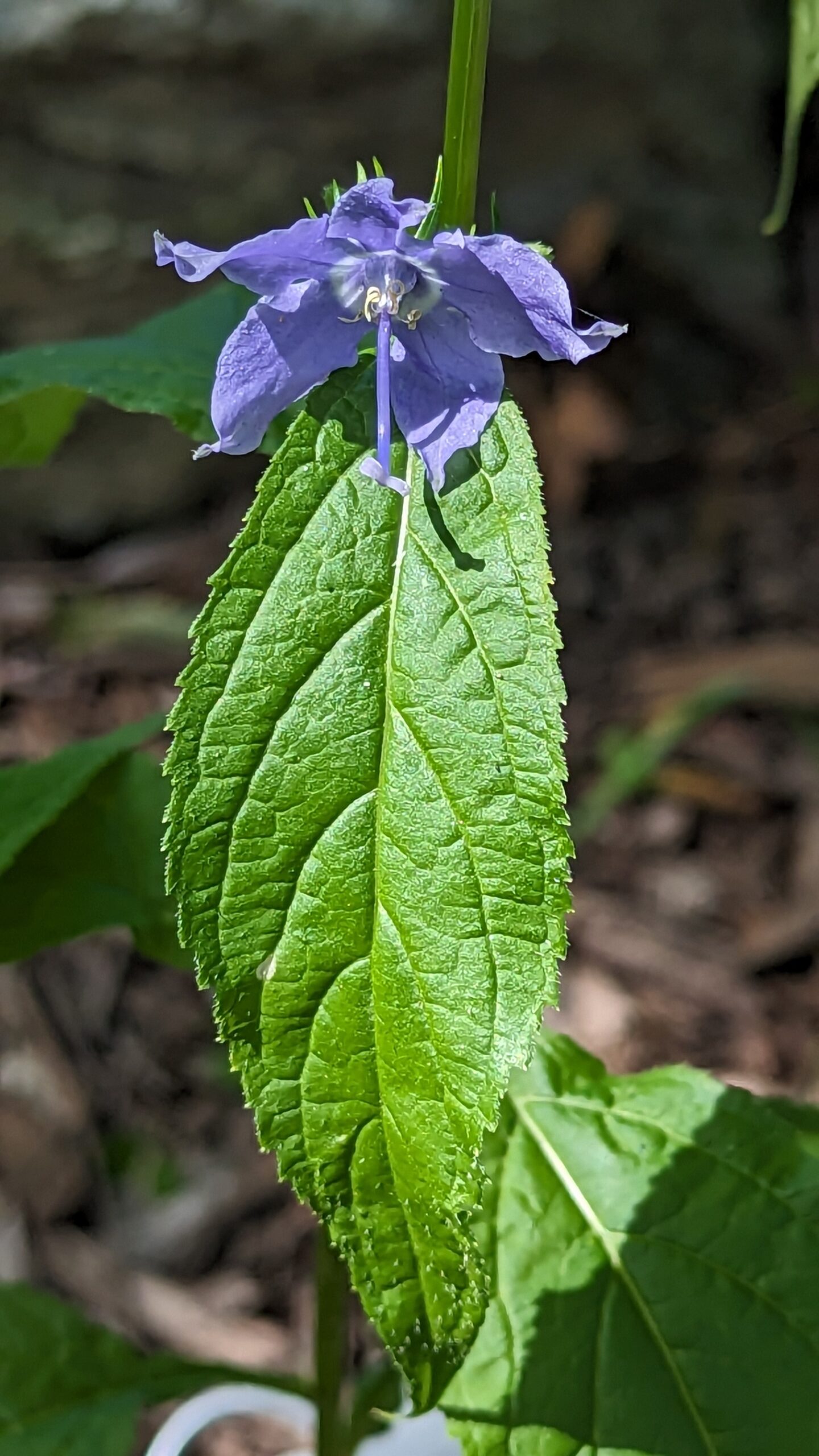
Monarda didyma (Beebalm) and Lobelia cardinalis (Cardinal Flower) are both in full flower right now in full light shade where they brighten dark corners with a brilliant flash of colour, and attract hummingbirds and butterflies. And new to my shade garden this year, but doing nicely, is the porcelain blue Campanulastrum americanum (American Bellflower). Lobelia inflata (Indian Tobacco, aka Puke Weed) is also flowering now in full (but relatively light), moist shade with delicate, pale bluish flowers.


Just starting to bloom in my shade gardens are Eurybia macrophylla (Large-leaf Aster), Eurybia schreberi (Schreber’s Aster), Aralia racemosa (American Spikenard), Ageratina altissima (White Snakeroot), Actaea racemosa (Black Cohosh), Scrophularia marilandica (Late Figwort) and Circaea lutetiana (Enchanter’s Nightshade). These are joined by a large patch of Impatiens pallida (Yellow Jewelweed). Even some Veronicastrum virginicum (Culver’s Root), another plant like Beebalm that isn’t normally thought of as a shade tolerant plant, is doing great under the dappled shade of Gymnocladus dioicus (Kentucky Coffeetree).


We also have some lovely plants suitable for part shade. These would normally be found at the edges of forests, and can tolerate quite a bit of shade. However, many of them tend to flower more prolifically with the benefit of more sunlight. Most books suggest that Solidago juncea (Early Goldenrod) requires full sun, but it is doing well under a large sugar maple in my yard where it gets only a half hour or so of direct, late afternoon sun. As its common name suggests, it is one of the earliest goldenrods to flower and starts flowering in my southwestern Ontario garden around the third week of July.

A number of other shade plants – mostly asters and goldenrods, but also some interesting woodland species – will start to bloom in the next few weeks but I’ll leave those for a later article. We also have lots of shade-loving ferns, grasses and sedges, and a few great shrubs for shade, but those, too, will have to wait.
Note that none of the plants listed above will thrive in deep shade such as that often found under Norway Maple, evergreens (like spruce or cedar) or close to the north side of a building, but they will all do very well in dappled shade (from less dense canopies such as under Kentucky Coffeetree) or if planted near the edge of the shade where they can get sun for at least part of the day. If you do have deep shade, you may want to consider some of our spring ephemerals mixed with ferns, for now.
Happy native plant gardening.
Crossword Puzzle #8
Enjoy!
Canada Lily
Some of the most popular posts on my Facebook page are the images of my Canada Lily (Lilium canadense). Technically not native to the part of Ontario that I live in (it could be classified as a “near native” here), it nevertheless thrives in my garden. Each year this plant sends up more shoots and has more blossoms.
I planted it as a small potted plant five years ago. A year later it was about 4’ tall and had two blossoms. The next year it shot up to just over 7’4” and had 24 blooms. Last year a second stalk appeared and the taller one reached an amazing 7’9” and there were 53 blooms between the two plants. This year, it just got bigger and more spectacular. A total of 8 stems produced 102 flowers and the tallest of these plants reached an incredible 7’11.5”.


In this month’s Plant of the Month I am writing about this amazing species. As usual, the Plant Description and In the Garden sections are courtesy of Shaun Booth from In Our Nature.
Common Name: Canada Lily
Scientific Name: Lilium canadense
Family: Liliaceae (Lily Family)
Alternate Common Names: Meadow Lily, Wild Yellow Lily, Yellow Wood Lily
Plant Description: Canada Lily features smooth, light green stems that are unbranched, except at the top where the flowers are found. Leaves are distributed along the stem in whorls of three to eight with some smaller alternate leaves occurring along the upper portion of the stem. Each leaf is up to 15 cm long, 2.5 cm wide, smooth, toothless, and narrowly ovate. Stems terminate with up to 20 nodding, trumpet-shaped flowers borne on long stalks and can range in colour from reddish orange to yellow. These flowers are up to 10 cm across and feature six tepals that flare backwards (but not past the base of the flower), six stamens, and dark dots on the inside of the tepals. Flowers become oblong, 5 cm long seed capsules that are divided into three cells containing flat seeds.


In the Garden: Canada Lily adorns the summer garden with trumpet-like flowers that hang gracefully from the plant. Besides its blooms, it is valued for its clumping habit and interesting whorled foliage.
Skill Level: Beginner to intermediate
Lifespan: Perennial
Exposure: Full sun to part shade (prefers dappled shade)
Soil Type: Rich loamy or slightly sandy soil
Moisture: Moist to medium
Height: 90–240 cm
Spread: 15–20 cm
Bloom Period: Jun, Jul, Aug
Colour: Red, orange, or yellow

Fragrant (Y/N): Y
Showy Fruit (Y/N): N
Cut Flower (Y/N): Y
Pests: The caterpillars of several moth species feed on the leaves, stems, and corms of Canada Lily, and the introduced Lily Leaf Beetle or Red Lily Beetle (Lilioceris lilii) feeds on its leaves
Natural Habitat: Wet meadows, moist rich woods, streamsides, and wetlands, and along wet roadsides and railroads
Wildlife Value: The nectar attracts large butterflies, particularly the Great Spangled Fritillary (Speyeria cybele) and various swallowtail butterflies. Some bees collect pollen from the flowers, but they are ineffective at cross-pollination because of their small size. A number of mammalian herbivores browse on the foliage, and voles and chipmunks are known to eat the corms. Rabbits ate off several new lilies I planted last year, and squirrels dug out the corms of others before I had a chance to cover them with chicken wire – but once established the plants seem pretty robust.
Butterfly Larva Host Plant For: None
Moth Larva Host Plant For: Carrion Flower Moth (Acrolepiopsis incertella), Burdock Borer Moth (Papaipema cataphracta), Golden Borer Moth (Papaipema cerina), Common Borer Moth (Papaipema nebris), Sparganothis Leafroller Moth (Sparganothis sulfureana)
USDA Hardiness Zones: 4–8
Propagation: [WC; D] Canada Lily seeds must undergo a period of one to two months of warmth, at which time they will swell and become a small bulb. These then need another 60 to 90 days of cold before they begin to sprout. Seedlings typically go dormant by midsummer. Plants grown from seed will take five to six years before they flower. Propagation is easiest from division of the scaly bulb, which can be dug as soon as the plant goes dormant in late summer.

Additional Info: Canada Lily is primarily pollinated by the Ruby-throated Hummingbird (Archilochus colubris) and large butteflies such as the swallowtails. Canada lily is listed as Threatened in Indiana.
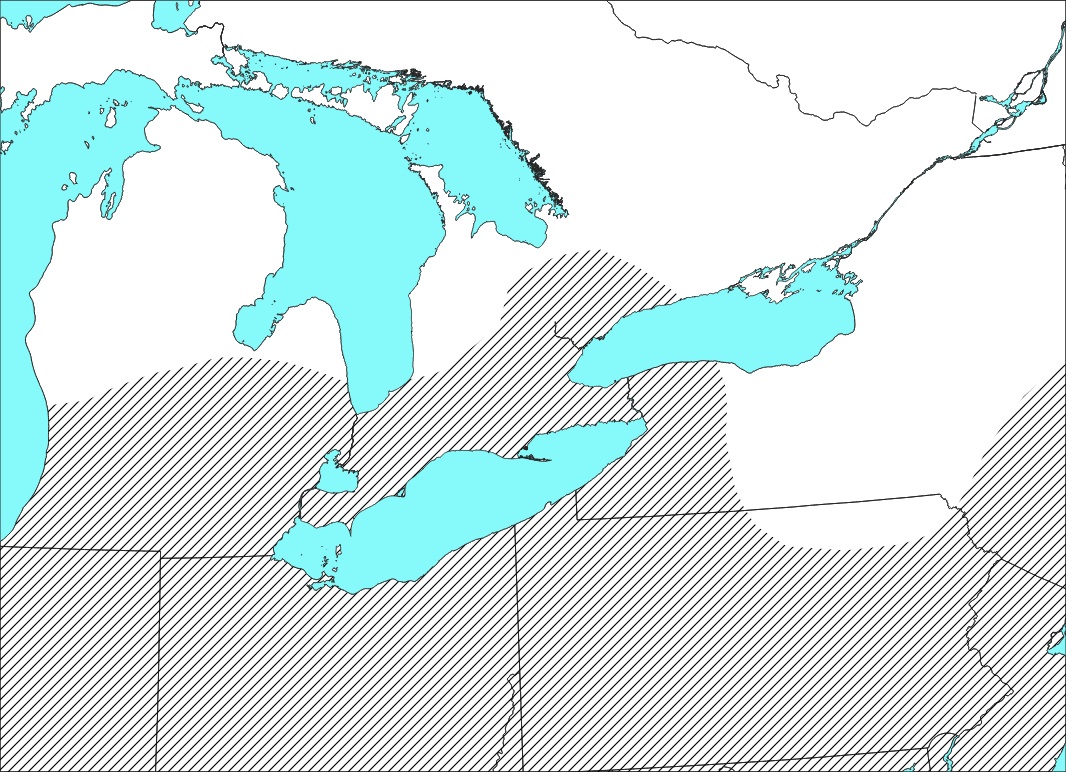
Native Range (shaded area on map):

July Jigsaw Puzzle
Click the button below to go to the July Jigsaw Puzzle! Have fun!
Pollinator Gardens and Bee Stings
A growing gardening trend is to plant pollinator gardens, often using native plants, to attract and feed bees and butterflies. This is occurring as a response to the news that our bees and butterflies are quickly disappearing. This realization likely started because honey bee farmers were faced with major financial losses as a result of Colony Collapse Disorder (CCD) starting in the early 2000s. Around the same time, folks began noticing that Monarch butterflies were in trouble. It wasn’t long till we also began to realize that our native bees were disappearing, too.
Honey bees are native to Europe and are really just another form of agricultural livestock, like cattle or hogs or poultry. Their loss, though economically difficult for honey producers, would not have the same ecological impact as the loss of our native bee species. After all, we likely have as many as 4,000 species of bees native to North America and these insects are critical for the successful pollination of most of our flowering plants – including much of our food. Many of our native bees are specialists, relying on one or a very few different kinds of plants. (Honey bees, on the other hand, are generalists – they will collect pollen from just about any plant.)


So to “save the bees” people have started growing native flowers, and creating pollinator gardens. These can be small backyard oases, restored farm fields, or educational gardens in parks, commercial areas or in school yards. However, a concern that often pops up – especially in school yards – is that with all those flowers, children are going to get stung.
People have a natural aversion to bee stings. And for good reason – they hurt. Some folks are severely allergic and must carry an epi-pen when they go outdoors.
When I was about 4 years old, my parents rented a farmhouse out in the country. At the end of a very long laneway (exceptionally long for a four-year-old) were two old, old apple trees. I saw what I thought were yellow “manure-flies” (at four I wasn’t very discerning). They were swarming between the two trees and I thought it would be fund to run through them and scatter them. My little four-year-old legs could not carry me up the long hill to the house fast enough and I got many nasty stings. Fortunately I don’t seem to be overly allergic.
Fast forward 15 years, and I am a counselor at a summer camp and am tasked with removing the bumble bee nest under the front step of one of the cabins. As I bent over to observe the results of my destruction, a bumble bee found my backside. I literally could not sit on that cheek for a week.
Fast forward another 50 years and I had to remove a homemade compost bin (made from old pallets) so an arborist could take down a couple of large mulberry trees. Halfway through the pile I discovered that 3 different species of flying insect had taken up residence in the pile – one looked like some form of bee, but the other two were obviously wasps (I didn’t stick around long enough to make a proper ID). My old 65-year-old legs could not carry me up the hill in my yard to the house fast enough to avoid getting a number of stings.


These three incidents are probably the most memorable of my encounters with bees and wasps, but by no means are they the only times I’ve been stung. And yet I plant lots of pollinator gardens in my yard and even though I get up very close and personal while I’m photographing the bees, I have never been stung or even threatened while around the flowers. (The one exception was when I inadvertently rested my weight on my hand on top of a ground nesting bee trying to exit its home – however, the sting was no worse than a fly bite and never even swelled up. I took it as simply a warning to “get off me”.)
So what is the real risk of getting stung around a pollinator garden? I would contend that it is exceedingly low. You are probably more likely to get stung walking down the sidewalk or opening your garden shed door. This is for a number of reasons.
First of all, most of our native bees are solitary. Many don’t even have stingers. And when they’re busy foraging amongst the flowers, they are not paying any mind to the large mammal (the human) that is nearby. This holds true even for the bees with stingers, such as honey bees and bumble bees (only the females of these species sting, by the way). Bees normally only sting if they feel threatened or if they are accidentally (or deliberately) molested or provoked.
Several wasps and hornets, on the other hand, live in colonies and are very territorial. They will sometimes sting if you simply get too close to their nest. (The yellow “manure flies” and the insects in my compost pile that stung me were all almost certainly wasps of some type and were simply protecting their colony.) Paper wasps, mud wasps, etc. like to build their nests in human-made structures – like your garden shed, or your garden-hose hanger, or even on your garage eaves. This is where you’ll most likely encounter these territorial insects, and where you’re most likely to get stung.


Another reason you’re unlikely to be stung around pollinator gardens is that bees and most wasps have very different diets. Many wasps are carnivores, filling their need for protein from insects (or in the fall, your picnic dinner). So the critters that are apt to sting you just for getting too close are not the ones that are going to be busy around your pollinator garden. (Some wasps DO hang around flowerbeds, drinking the nectar, but I have never found any of these to be the least bit aggressive.)


So, if your child’s school, or your employer, or your neighbour, decides to put in a pollinator garden to help stem the decline of these extremely important insects, you needn’t worry about getting stung. A little bit of care and some education can make this a win-win scenario. And if you or your child is highly allergic – just remember to carry your epi-pen. And keep in mind that the pollinator garden is a very unlikely source of bee stings.


Happy Native Plant Gardening.
Crossword Puzzle #7
Have fun!
Butterfly Milkweed
As I write this in mid-June, the Butterfly Milkweed in my southwestern Ontario garden is just starting to get an orange tinge to the flower buds. This brilliant orange flower loves sun and sand and its tuberous root (from which it gets its specific epithet – tuberosa) makes it a great drought tolerant choice for the garden. A favourite of butterflies, bees, wasps and other insects, no sun-drenched garden should be without it. Plant Description and In the Garden sections, below, are courtesy of Shaun Booth of In Our Nature.

Common Name: Butterfly Milkweed
Scientific Name: Asclepias tuberosa
Family: Asclepiadaceae (Milkweed Family)
Alternate Common Names: Butterflyweed, Chigger Flower, Orange Milkweed, Pleurisy Root
Plant Description: Butterfly Milkweed is characterized by rigid, hairy stems with lance-shaped, alternate leaves attached with little to no leaf stalk. Leaves measure about 5-15cm long and 2.5cm wide and are toothless, glabrous on top, sparsely hairy underneath and end with a pointed tip. Only the foliage exudes a milky sap. Stems are mostly unbranching except for at the top where several flat-topped flower clusters, up to 8cm across, can be found. Each cluster is made up of up to 25 individual flowers measuring about 1cm across. Flowers are characterized by 5 hoods with a curved horn emerging from each one and arching towards the central crown. Each flower has 5 backwards flared petals. Flowers give way to narrow, smooth, 15cm long seed pods. Each pod contains numerous flat brown seeds with tufts of white silk that allow them to be carried by the wind.


In the Garden: Butterfly Milkweed is valued in gardens for its cheerful orange flowers, long bloom time and high drought tolerance. It maintains a clumping form and is not an aggressive spreader which makes it suitable for small or formal gardens. The deep taproot makes it hard to transplant, so choose its location wisely. Stems remain upright well into the winter months.


Skill Level: beginner
Lifespan: perennial
Exposure: full sun – not shade tolerant
Soil Type: prefers sandy or rocky soil that is well-drained
Moisture: dry to medium
Height: 80 cm
Spread: 45 cm
Bloom Period: Jun, Jul, Aug
Colour: orange
Fragrant (Y/N): N
Showy Fruit (Y/N): N
Cut Flower (Y/N): Y
Pests: no serious insect or disease problems, though crown rot can be a problem in wet, poorly drained soils and it is susceptible to rust and leaf spot.
Natural Habitat: prairies, open woods or on roadsides
Wildlife Value: nectar source for native bees, butterflies and hummingbirds


Butterfly Larva Host Plant For: Monarch butterfly (Danaus plexippus), Grey Hairstreak (Strymon melinus), and Queen butterfly (Danaus gilippus)


Moth Larva Host Plant For: Unexpected Cycnia (Cycnia inopinatus), Delicate Cycnia (Cycnia tenera), Milkweed Tussock Moth (Euchaetes egle), Stalk Borer Moth (Papaipema nebris), Isabella Tiger Moth (Pyrrharctia Isabella), Striped Garden Caterpillar (Trichordestra legitima)
USDA Hardiness Zone: 3-9
Propagation: Seeds sown in the spring require 30 days cold stratification. Plants are easily grown from seed, but are somewhat slow to establish and may take 2-3 years to produce flowers. Butterfly Milkweed does not transplant well due to its deep taproot, and is probably best left undisturbed once established. The quickest method of propagation is root cuttings. In the fall, cut the taproot into 2-inch sections and plant each section vertically, keeping the area moist.


Additional Info: Unlike many of the other milkweeds, this species does not have milky-sapped stems. Asclepias tuberosa will host monarch butterfly caterpillars but if other milkweeds are present this one is often ignored.
Native Range:

June Jigsaw Puzzle
Click the button below to visit the puzzle page!
Why I Grow Native Plants
This month’s article is going to get personal. It won’t be a “how-to” or a “what to grow where” blog. Instead, I’ll share a bit of my personal journey into native plant gardening – a journey that has gone from curiosity to complete addiction.
I was lucky as a kid in that we often lived in rural areas and, when we didn’t, I had my uncle’s farm to visit for the entire summer holidays. We also camped a lot. Because we moved around a lot, I didn’t develop many long-lasting friendships and so I became a bit of a loner. But I had Mother Nature around me as a friend so I was quite content.

Fast forward a few decades and I went off to university (in my 40s) and enrolled in a BSc in Environmental Sciences degree program where I took a major in Natural Resources Management and a minor in Landscape Ecology. This was followed by a master’s degree in Environmental Biology. After graduating from there, I took a year of Advanced GIS Applications (computer mapping) and at the sweet young age of 50 I was ready to start life over with a new job, a new mortgage – and a pile of student loans to pay off. I managed to get a job in Ridgetown, Ontario at a satellite campus of the University of Guelph that allowed me to teach part time, eventually becoming a full-time teaching gig.
After a couple of years of getting my life in order, it was time to start gardening again. I had been an avid gardener – veggies, mostly – most of my life. I started, as many do, by planting the things I knew – hostas, tea roses, tulips, and (I shudder to remember it) periwinkle, goutweed, and some other nasties.


Then, one day, I saw a packet called “Wildflower Mix” and thought these might be nice. After all, I grew up with lots of wildflowers around me on the farm and when camping. At this point I still didn’t realize that wildflowers and native plants weren’t necessarily the same thing.
The next year when things started popping up in the garden that I knew were European in origin, I started doing my homework. To my surprise (and, in some cases, disappointment) I found out that many of my favourite flowers in the fields of my childhood were also of European or other origins – garden escapees like chicory, mullein, teasel, and so on. And that packet of wildflower seeds? Of about 12 species, only one was native to where I live and a second one was a ‘near native’.
I decided to remove the non-natives from that new flowerbed and plant some true natives – goldenrods, beebalm, black-eyed Susan – and it wasn’t long before I started seeing that these new flowers had WAY MORE bees and other insects on them than the non-native ones did. And I started buying books about growing Native Plants – like Lorraine Johnson’s “100 Easy to Grow Native Plants” and “Grow Wild”.
In the beginning, I still gardened with my old gardening aesthetic – I bought plants that looked exotic (including a few cultivars like “Hello Yellow” butterfly milkweed, an almost purple cardinal flower, etc.) But the more I read, the more I began to appreciate that true species often provide more benefit to wildlife than their cultivars do.


Soon I had a second bed of natives, then a third, and eventually all the non-native plants and cultivars had been removed from my half acre back yard and replaced with natives or “near natives”. There are few thrills as satisfying as standing in front of a bed of flowering wild bergamot watching at least a dozen different species of bees, some wasps, butterflies and the fabulous clearwing hummingbird moth all busy collecting pollen and/or nectar. Or witnessing the perfect relationship between the giant black digger wasp and dotted horsemint (Monarda punctata) – check out my blog on that plant to learn more about these two.


The more I learned, the more I planted. The more I planted, the more I wanted to share my discoveries and newly-gained knowledge. Pretty soon my focus was no longer on what I found particularly pretty, but what provided the most benefit to insects and birds.
By the time I hit about 250 species of natives and near natives in my yard, I started to look for some of the rarer plants for which I might be able to provide a healthy seed bank. Whenever possible, I buy almost exclusively from reputable native plant nurseries.


At last count (I am a spreadsheet guy, after all), even after I had over 20 species that didn’t make it through this past winter, I still have well over 320 species of native flowers, grasses, sedges, shrubs, vines and trees in my gardens – which have now expanded to the front yard as well. And I have a wish list of plants that is way bigger than what I can possibly find room for in my yard (well, perhaps I can squeeze them in somewhere).
And because I like to share what I’ve learned (as any good teacher does), I open my gardens to organized garden tours a few times a year and I talk to groups and anyone else who will listen about the benefits of growing native plants.


I’ve often joked that it’s an addiction – but what better addiction than growing beautiful native plants that feed the insects that feed the birds, or that provide seeds directly to the birds. It’s my little payback to Mother Nature for all she taught me when I was young.
Happy Native Plant Gardening
Rick