Spotted Jewelweed
Areas with a fair bit of moisture are perfect candidates for this beautiful annual flower, often found along shady stream banks and in low forested wetland areas. Long known for the ability of its crushed stems to cure the itch of mosquito bites or even poison ivy, its exploding seed pods are also a favourite of children of all ages. Plant Description and In the Garden sections, below, are courtesy of Shaun Booth of In Our Nature.

Common Name: Spotted Jewelweed
Scientific Name: Impatiens capensis
Family: Balsaminaceae (Touch-me-not Family)
Alternate Common Names: Orange Balsam, Orange Jewelweed, Spotted Touch-me-not, Wild Balsam
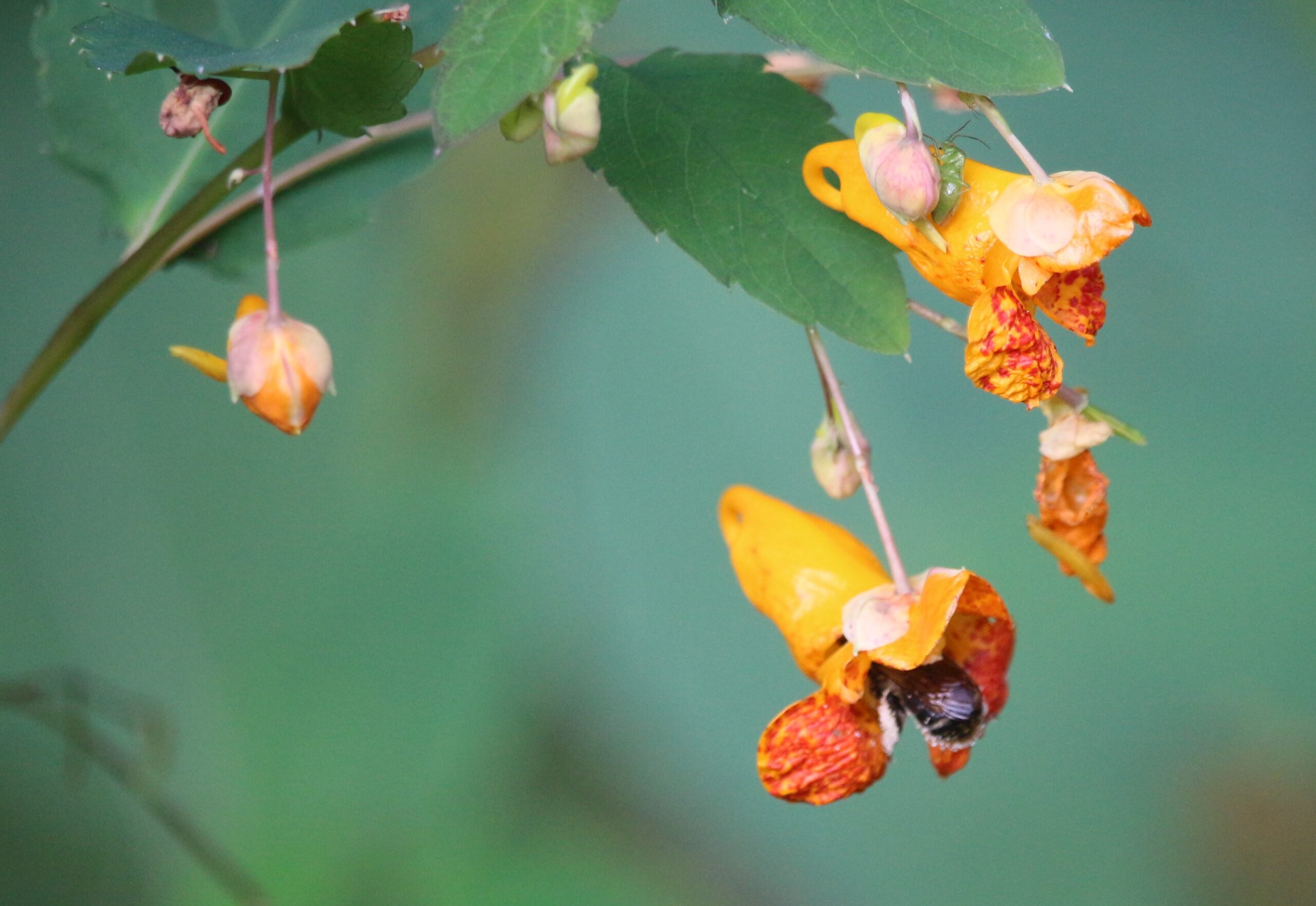
Plant description: Jewelweed is a heavily branched plant with smooth, succulent stems that are reddish green and nearly translucent. Oval to egg-shaped leaves are borne in an alternate pattern and measure up to 7.6cm long and almost 3.8cm wide. They are smooth to the touch with widely spaced, broad teeth. Flowers measure 2.5cm long by 2cm wide and emerge from upper leaf axils (where the leaf meets the stem) in small clusters of 1-3 flowers. Each flower is tubular in shape with two broad lower lobes and one smaller upper lobe. Sticking out from the back of each flower is a long, narrow nectar spur that curls back underneath of the flower. Colour can vary but they are usually orange with red spots on the front petals. Note that these red spots may be very dense or even completely absent, depending on the specimen. Flowers give way to thin green seed pods that pop open from the slightest touch to spread their seeds away from the mother plant.


In the Garden: The vibrant orange flowers of Jewelweed dangle gracefully between its lush foliage, blooming for months on end. It will eagerly self-seed and quickly cover shady, moist areas with beauty and wildlife value.


Lifespan: annual
Exposure: shade to part shade
Soil Type: fertile clay, loam, sand with an abundance of organic material
Moisture: moist, wet (submergence of the roots by flood water is tolerated for up to 2 weeks without apparent ill-effects)
Height: 90-150 cm
Spread: 45-75 cm
Bloom Period: Jun, Jul, Aug, Sep, Oct (till frost)
Colour: orange
Fragrant (Y/N): N
Showy Fruit (Y/N): N
Cut Flower (Y/N): Y
Pests: few pest problems
Natural Habitat: shady wetlands
Wildlife value: Hummingbirds and butterflies seek nectar, and several native bees (listed by the Xerces society as of special value to bumblebees) collect pollen; deer will browse the foliage, while mice and many birds eat the seeds
Butterfly Larva Host Plant For: none
Moth Larva Host Plant For: Obtuse Euchlaena (Euchlaena obtusaria), Pink-Legged Tiger Moth (Spilosoma latipennis), White-Striped Black (Trichodezia albovittata)

USDA Hardiness Zone: 2-11
Propagation: [CWC, L, M] Seeds are best sown when fresh as they do not tolerate drying out. Jewelweed seeds need light to germinate and a period of cold moist stratification, followed by warm moist period, then another period of moist cold. They typically require 2 years to germinate in the wild, though depending on the winter conditions they may germinate after the first winter.


Additional Info: The juice from jewelweed stems contains a compound called lawsone which has shown to have antihistamine and anti-inflammatory properties. It is said to relieve itching from poison ivy mosquito bites, stinging nettle and has also been used to treat athlete’s foot.
The plant gets one of its common names, ‘touch-me-not’ because when the ripe seed pods are touched even lightly, the pods’ explosive spring-action projects the seeds for a distance of a meter or more.
From my YouTube videos – this is a jewelweed seed pod “exploding” recorded at 1/8 normal speed. It’s no wonder their seeds find their way far from the parent plant.
Native Range:

Very similar to Yellow Jewelweed:
Scientific Name: Impatiens pallida
Common Name: Yellow Jewelweed


Alternate Common Names: Balsam-weed, Pale Jewelweed, Pale Snapweed, Pale Touch-me-not, Quick-in-the-hand, Silverweed, Slippers, Slipperweed, Snapweed, Speckled Jewels, Spotted Touch-me-not, Wild Balsam
Yellow Jewelweed has fewer, but larger, yellow flowers than Spotted Jewelweed, with a shorter spur that bends down rather than parallel with the flower. It also has more finely toothed leaves and is a much larger plant overall. I. pallida also seems to prefer soils on the sandier end of the spectrum vs I. capensis, which seems to favour heavier soils.
USDA Hardiness Zone: 3-7
Native Range:

Boulevard Gardens
A Note on Boulevard Gardens
Most suburban, and some urban, yards have a narrow grass strip between the sidewalk and the street. Invariably the municipality requires you to maintain this strip despite it being their property. And because it is their property, they often have restrictions as to what you can or can’t do with it (always check with your municipality before creating a boulevard garden). Some of these restrictions make total sense – like the ones that say don’t plant tall things that will block driver and pedestrian visibility, don’t plant tall shrubs or trees that may interfere with overhead wires, or don’t place large boulders that could interfere with maintenance (including snow removal) equipment. In addition, because it is municipal property, municipal work crews have a legal right to access it any time for maintenance of overhead or underground infrastructure, or when repairs to sidewalks, curbs and streets are necessary. As a result, your nicely tended flower bed could be unavoidably trampled.

So, what CAN you do with this area – an area that I have often seen referred to as a “hell strip”. These strips get this reputation because they are often comprised of compacted fill from when the street and/or sidewalk was put in. They get salt deposited when snowplows push snow onto them. Melting snow and contaminated street water get splashed onto them when cars drive by. And they’re very handy spots for pets to “do their business” when being walked. It’s a wonder anything grows there at all.
However, if properly planned, these otherwise boring grass strips can provide year-round natural beauty, excellent pollinator habitat, an opportunity to educate your neighbours, and can even reduce maintenance – no weekly lawn cutting is necessary.
But you need to choose your plants wisely. Boulevards require plants that not only tolerate the shade/sun/moisture conditions that may be present, but also a certain amount of salt accumulation, dog urine and even some trampling by pets and neighbourhood kids, all while meeting stringent height restrictions. These plants have to be extra tough. But we have lots of native plants to choose from (a very abbreviated list at the end of this article provides just a few examples).
Creating the Boulevard Garden
Call before you dig. Often utilities are buried in, or very near to, boulevards. Telephone (now usually used for your internet) and cable lines, in particular, are often buried in very shallow trenches – more often than not by simply inserting a spade into the ground and dropping the line in. Pushing your shovel into the ground can easily sever these wires (I speak from experience!).
Some municipalities require you to apply for a permit and there may or may not be a cost associated with this. Depending on where you live, the municipality has the right to rip out unauthorized plantings on their property and even bill you for the labour involved. So check very carefully – you can usually find the information on the municipality’s website.
Once you get permission and know your municipality’s rules on boulevard gardens, and your utilities have been located, you can start to plan the garden.
What do You Have to Work With?
Let there be light!
First of all, determine the general conditions of your hell strip. Is it full shade, part shade or full sun? One way to figure this out is put a couple of stakes in the ground where you want to plant, then check it mid-morning, noon, and late afternoon so see how much light the plants will get. This will greatly narrow the selection process for picking your plants. Although it is not a hard and fast rule, most sources will say that anything greater than 6 hours of direct sun is considered full sun. Part sun (or part shade) is usually considered as 4-6 hours of sun. Full shade does not mean NO sun as most plants require some sunlight, even if it is diffused or dappled. Full shade usually means 4 hours of sunlight or less.
All the Dirt
Is the underlying soil clay, sandy, or construction rubble? This will likely depend on a LOT of things – how old your neighbourhood is, how recently the streets and sidewalks had a major repair (such as sewers being dug up), and what the parent soils are.
It might take a bit of research, but you can find out your soil type by Googling ‘Soil Maps’ and your province/state (sometimes even municipalities will be able to provide this info).
You can also dig a hole and do a percolation test – these are regularly done for septic beds to determine the size of bed needed – and use the results to determine soil type. To do the perc test, dig a hole 15 to 30cm deep, fill the hole with water a few times and let it drain out to saturate the soil (this could take a several hours – especially if you have heavy clay). Put a ruler in the hole that extends to the top and fill the hole with water again and monitor how long it takes for the hole to empty (be patient, this is a slow process).
If the water infiltrates 20-30 mm/hr, the soil is sandy loam. If it only goes down 10-20 mm/hr, you have loam soil, 5-10 mm/hr is clay loam, and if the water only drops 1 mm/hr then you know you have clay soil. (I did say it was a slow process.)
Another way to determine soil type is by doing a ribbon test. A soil expert can do this with confidence, but I always find the ribbon test to be quite subjective. There are great videos online on how to do a soil ribbon test and how to interpret it if you want to try that.

Wet or Dry?
Are you on the top of a hill where all the water will run away? Are you at the bottom where it will collect? I’m at the top of a knoll and have a very wide boulevard, but it was contoured as a shallow ditch to take water away. Unfortunately (or maybe fortunately) my neighbour’s drive is raised enough that in very heavy downpours water can accumulate. In my case it doesn’t last long as I have very sandy soil, but if this was clay soil, I’d have a mini lake every time it rained and would need to find plants that could stand having their feet wet for extended periods. If you are on sandy soil, with full sun, you are going to be limited to prairie species that can tolerate drought. If your boulevard is well shaded, especially if you have heavy clay soil as well, you won’t be able to grow typical prairie plants at all.
What Grows Well in a Hell Strip?
As promised, here are a few plants that are tough enough for the most common boulevard conditions, are typically 3’ (1m) tall or less, sorted by growing conditions. This list is by no means exhaustive but is meant just to get you started.
Dry, well drained soils, full sun

- Achillea millefolium (Yarrow)
- Aquilegia canadensis (Wild Columbine)
- Asclepias tuberosa (Butterfly Milkweed)
- Bouteloua curtipendula (Side-oats Grama) – grass
- Ceanothus americanus (New Jersey Tea) – shrub
- Coreopsis lanceolata (Lance-leaf Coreopsis)
- Eragrostis pectinacean (Purple Lovegrass) – grass
- Fragaria virginiana (Wild Strawberry)
- Geranium maculatum (Wild Geranium)
- Geum fragarioides (Barren Strawberry)
- Geum triflorum (Prairie Smoke)
- Penstemon digitalis (Foxglove Beardtongue)
- Penstemon hirsutus (Hairy Beardtongue)
- Pycnanthemum virgianum (Virginia Mountain Mint)
- Rudbeckia fulgida (Orange coneflower)
- Rudbeckia hirta (Black-eyed Susan)
- Schizachyrium scoparium (Little Bluestem) – grass
- Solidago nemoralis (Gray Goldenrod)
- Solidago rigida (Stiff Goldenrod)
- Sporobolus heterolepis (Prairie Dropseed) – grass
- Symphyotrichum oolentangiense (Sky-blue Aster)
Dry, Shade to Part Shade


- Antennaria parlinii (Parlin’s or Smooth Pussytoes)
- Asarum canadense (Wild Ginger)
- Asclepias exaltata (Poke Milkweed)
- Campanula rotundifolia (Harebell)
- Elymus hystrix (Bottlebrush Grass) – grass
- Eurybia macrophylla (Largeleaf Aster)
- Geranium maculatum (Wild Geranium)
- Geum fragarioides (Barren Strawberry)
- Oenothera biennis (Evening Primrose)
- Penstemon hirsuta (Hairy Beardtongue)
- Phlox divaricata (Wild Blue Phlox)
- Polygonatum biflorum (Solomon’s Seal)
- Tiarella stolonifera (Foamflower)
- Solidago flexicaulis (Zigzag Goldenrod)
- Solidago ptarmicoides (Upland White Goldenrod)
- Viola pubescens (Downy Yellow Violet)
Heavy Clay Soils, Full Sun Part Shade
- Achillea millefolium (Yarrow)
- Allium cernuum (Nodding Wild Onion)
- Asarum canadense (Wild Ginger)
- Asclepias incarnata (Swamp Milkweed)
- Carex blanda (Common Wood Sedge) – sedge
- Carex glaucodea (Blue Wood Sedge) – sedge
- Coreopsis lanceolata (Lanceleaf Coreopsis)
- Elymus hystrix (Bottlebrush Grass) – grass
- Fragaria virginiana (Wild Strawberry)
- Geranium maculatum (Wild Geranium)
- Geum fragarioides (Barren Strawberry)
- Monarda didyma (Beebalm)
- Monarda fistulosa (Wild Bergamot)
- Pycnanthemum virginianum (Virginia Mountain Mint)
- Rudbeckia fulgida (Orange coneflower)
- Rudbeckia hirta (Black-eyed Susan)
- Solidago flexicaulis (Zig-zag Goldnerod)
- Symphyotrichum lateriflorum (Calico Aster)

A special thank-you to all the folks that offered up photos of their boulevard gardens to make this article possible.
Happy Native Plant Gardening
Book Review – The Gardener’s Guide to Prairie Plants
The Gardener’s Guide to Prairie Plants
By Neil Diboll & Hilary Cox
- Publisher: University of Chicago Press, 2023
- Paperback: 644 pages
- ISBN-10: 022680593X
- Dimensions: 6” X 9”
- Price: $47.31 (Amazon.ca); $34.99 (Kindle only – Amazon.com)

As both a gardener and a bibliophile, I splurged to buy this book (over $50 with tax here in Canada) because it sounded like an awesome guide to native plants, even if it was for a region slightly west of where I am in southern Ontario. And as a book collector (some might say hoarder) I have lots of books on my shelf that I seldom open after the initial reading. Was it worth the money? Yes and No.
In the Introduction, the authors state that it is “intended for use by both gardeners and professionals”. I would argue that it would make an awesome textbook for a college or university level course on prairie restoration. And though it does have considerable merit for the native plant gardener – there ARE a lot of things to like about this book, after all – there are also a few things that I find frustrating or questionable.
What I Liked
For starters, The Gardener’s Guide to Prairie Plants is a very well produced volume from the University of Chicago Press with excellent quality paper and a sewn, rather than glued, binding so it should be extremely durable. It’s a hefty volume – well over 600 pages long. (Out of curiosity I stuck it on my kitchen scales and it weighed in at almost 3 lbs – you’ll not likely carry this around on your next trip to the garden center!)
The book contains your typical introduction that you find in this genre with chapters on how to use the book (including a section on the use of scientific names), the ecology of prairie, understanding your soil, and on designing, planting and maintaining a prairie garden. The chapters on ecology and soil are very typical of a school textbook with some good science written in an understandable way. The chapter on designing, planting and maintenance of prairie gardens is more geared to the average home gardener and offers lots of useful tidbits, such as why using cocoa bean hulls as mulch isn’t such a great idea (they can be toxic to pets).
Chapter 5, entitled “Prairie Species Field Guide”, is where the meat of the book begins. This section covers 148 species of prairie plants – chosen, for the most part, because they are commonly used in gardens, though the authors do include a few that are less common which they think should be in our gardens, too.
This “Field Guide” is, in my opinion, the best part of the book from a gardener’s perspective. For each plant the book is divided into two facing pages – on the first page the authors provide the scientific name, followed by one or two common names, and the family to which the plant belongs. This is immediately followed by three or four sentences about the plant.


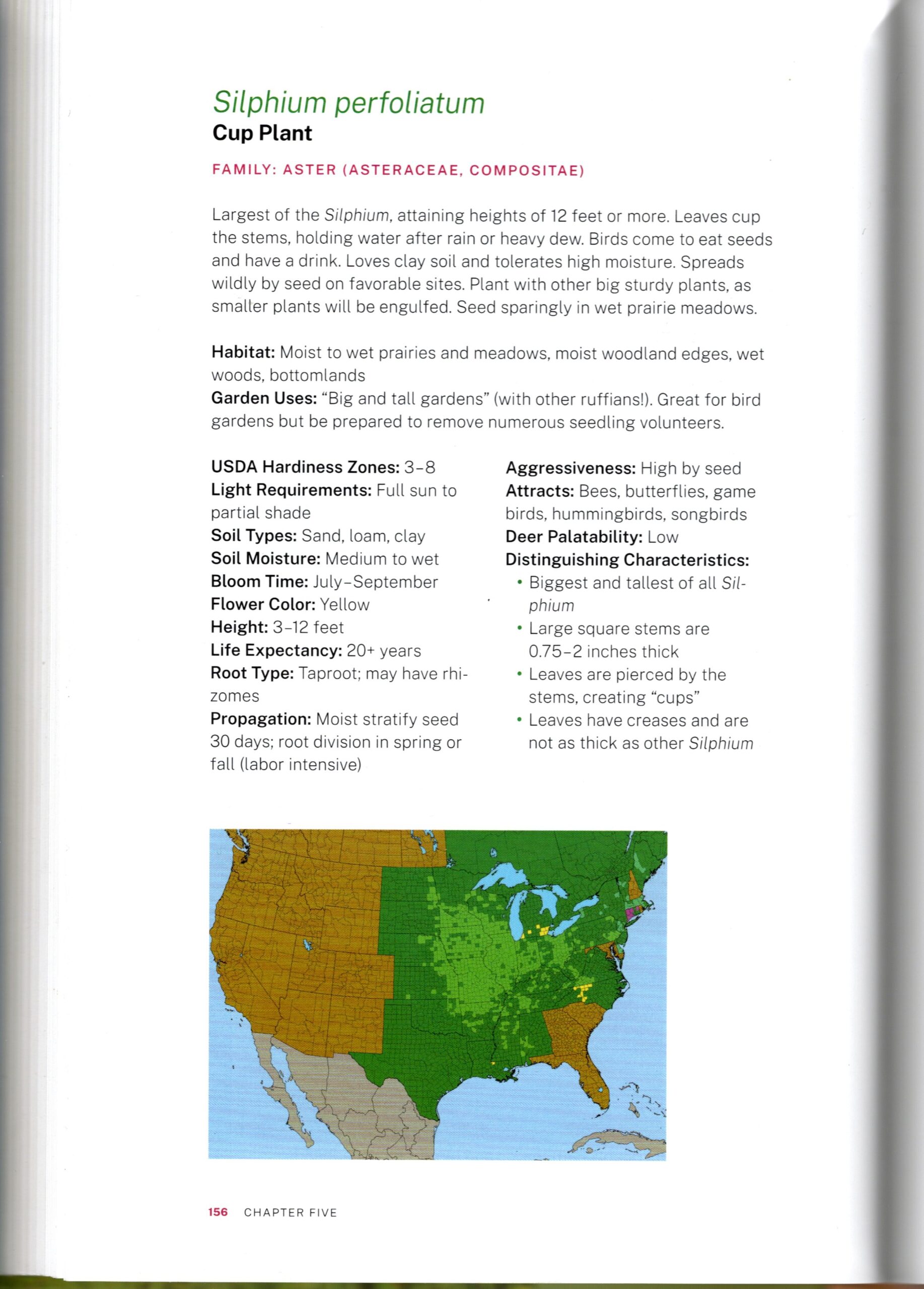
The rest of the page consists primarily of bullet points covering topics such as habitat; uses in the garden; USDA Hardiness Zone; soil, moisture and light requirements; size and flower colour; aggressiveness; and even a brief note on propagation. It then lists a few bullet points on distinguishing characteristics, and finally, at the bottom of the page, it includes a map of the plant’s range in the US and the southern edge of Canada (more about the range maps later).
The second page consists primarily of photos. This is another unique and commendable inclusion in the book. So many native plant gardening books show a picture of a flower, or of the plant in situ, and a couple even show a photo of a seedling. But this book shows all of these, plus a picture of the seedhead, of a leaf, and of an emerging mature plant. At the bottom of the page is a paragraph identifying look-alike plants. All extremely useful for both new and experienced native plant gardeners alike.
The next 45 or so pages (Chapters 6 & 7) cover establishing and maintaining a prairie meadow. This section seems more geared to land restoration folks than your average native plant gardener. It’s interesting, but to a home gardener not all that relevant.
Chapter 8 is all about collecting seeds and propagating plants from those seeds. Chapter 9 covers propagating plants vegetatively. Both chapters would be useful for all intended audiences.
The Parts I Was Less Thrilled About
Up to this point we have covered just over 400 of the 644 pages. If they had stopped here, it would have been a great tool for gardeners, but MOST (not all) of the rest of the book seems far more appropriate for a college textbook or a landscape restoration manual than a Gardener’s Guide.
Chapter 10 devotes over 30 pages to ‘The Prairie Food Web’, from pollinators up through the web to rattlesnakes and bison (even though it might be exciting to see a bison in my garden, I think it is pretty unlikely to happen in my fenced-in suburban yard).
The next almost 200 pages are dedicated to tables. Lots and lots of tables with lots of cool information – from a purely academic standpoint, anyway – but overkill to say the least. If you can quantify it, there’s probably a table here for it. Everything from prairie seed mixes to tables on plant characteristics, on wildlife attracted, on aggressiveness of the plants, etc., etc. These tables provide a wealth of information for landscape restorers, but the font is small and the tables span multiple pages making them difficult to read. I’m not sure how many gardeners would take the time to find what they’re looking for in the tables. Most of the relevant information is already, or could easily be, incorporated into the plant descriptions in Chapter 5. Chapter 11 (Seed Mixes) consists of 12 tables spread over 34 pages while Chapter 5, simply called Tables, has 30 tables spread across 142 pages.

The second issue I have with the book is the way the plants are organized. I do like that the plants are listed in alphabetic order by scientific name, but they are subdivided first into Monocots, Dicots, and Grasses & Sedges and then further subdivided by family. How many home gardeners are going to know if the plant they are looking for is a monocot or a dicot or if it is Asteraceae or Fabaceae. How many will even care. Include this information on the plant page if it’s that important, but don’t divide the book into these sections. It just takes that much longer to find the plant you’re looking for.
The only other beef I have about the book is about the range maps. The maps are simply reproductions of the Biota of North America Program (BONAP) maps available on the BONAP website. These maps are pretty useful – if you live in the US – because they show plant presence on a county basis. In Canada, they only work at a provincial level which is next to useless if I want to know if a plant is actually native to where I live. And, like the complaint I have with so many American publications, the map only covers as much of Canada as is needed to capture the lower 48 states in one image. My research shows that there are more nurseries and garden centers promoting and selling native plants in southern Ontario alone than in any state in the US. We are a big market for native plant gardeners.
The other complaint I have about the BONAP maps is the lack of clarity about what the colour coding actually means. The legend indicates that the light green represents “Species present and not rare” – but “present’ and “native” aren’t necessarily the same thing. Another shade of green (very similar to the first one) indicates “Species native, but adventive in state”. Adventive, by definition, means “not native” (Dictionary.com), or “introduced to a new area and not yet established there; exotic” (Collins Dictionary). How can it be both native and exotic? Some time ago I reached out to BONAP to get clarification on the definitions but was no further ahead after getting a response.
What’s worse, the book doesn’t even include a legend to explain the colour coding for anyone not familiar with the maps, nor did I find any reference to the source of the maps to acknowledge where they came from or to allow the reader to look up the map themselves.
And the reproduction of the maps leaves something to be desired. By necessity they are small. Which means it is extremely difficult to differentiate the shades of green. For example, in the images below I have the original BONAP map for Silphium perfoliatum (Cup Plant) and I have circled those counties where it indicates “adventive”. Beside it is the same map from the book. Your eyes are a lot better than mine if you can differentiate the shades of green. And it is important to do so because Cup Plant is not native to New York state and is actually considered invasive there – it is illegal to sell or to grow it for sale in that state.


Range maps, like the ones in Flore printaniére by Gisèle Lamoreux (published by Fleurbec in Quebec, Canada) would have been much more useful.


Summary
Overall, this is a beautiful but pricey book. The “Field Guide” portion in the middle, with better range maps, would have made an excellent gardener’s guide on its own, and the resulting smaller volume would have made it more affordable to non-professionals. And because I have lots of books on my shelf that I have only read once, one more isn’t going to hurt so I will keep it. But whether you think it’s worth the price will depend on your book budget.
Happy Native Plant Gardening.
Rick
© The Native Plant Gardener 2023
Caltha Palustris – Marsh Marigold
Caltha palustris is a very early blooming wetland species that brightens the forest floor each spring. Its bright yellow flowers seem to almost glow on the damp forest floor. Plant Description and In the Garden sections, below, are courtesy of Shaun Booth of In Our Nature.

Common Name: Marsh Marigold
Scientific Name: Caltha palustris
Family: Ranunculaceae (Buttercup Family)
Alternate Common Names: Boots, Brave Bassinets, Bull Flower, Cow Lily, Cowslip, Crazy Beth, Crowfoot, Drunkards, Goldes, Gools, Horse Blob, King’s Cup, Mare Blob, Marybuds, May Blob, Meadow Buttercup, Meadow Cowslip, Meadow Gowan, Meadow-bright, Mireblob, Publican’s Cloak, Publicans-and-sinners, Soldier’s Buttons, Water Boots, Water Buttercup, Water Cowslip, Water Dragon, Water Goggles, Water Gowan, Yellow Gowan, Yellow Marsh Marigold (and a whole lot more!)
Plant description: Marsh Marigold features hairless, hollow, regularly branching stems. The leaves are mostly basal, although a few alternate leaves can be found along the stems. Leaves measure 10cm long and across (alternate leaves are smaller), are round to kidney shaped with a deeply heart-shaped base, have scalloped to toothless edges and a succulent look to them. Small clusters of 2-5 yellow flowers are found on upper stems. Each flower measures 2cm – 4cm across and features 5-9 rounded, waxy, petal-like sepals surrounding a ring of numerous yellow stamens (the part that holds the pollen).


Flowers give way to clusters of flattened, curved capsules (resembling a jester’s hat) with each capsule measuring about 1cm long. They start out erect and green then curve outwards and become a light brown colour with age. They split open at the top to release greenish brown seeds.
In the Garden: In early spring, the cheerful yellow flowers of Marsh Marigold glow in enthusiasm for the warmer weather ahead. This plant is easily grown in wet, mucky soil, in the shallow water of a pond or a rain garden. Give it rich soil and never allow it to dry out. It is a well-behaved plant with a low-mounding habit. It spreads by seeds and rhizomes to form colonies but is not an aggressive spreader. Although its name suggests that it is related to marigolds, it belongs to the buttercup family.
Skill level: beginner
Lifespan: perennial
Exposure: full sun to part shade (will tolerate full shade but is less likely to produce flowers)
Soil Type: muddy, humus-rich soil
Moisture: wet
Height: 30-45 cm
Spread: 30-45 cm
Bloom Period: Apr, May, Jun
Colour: yellow
Fragrant (Y/N): N
Showy Fruit (Y/N): N
Cut Flower (Y/N): N
Pests: no serious insect or disease problems though it may be susceptible to powdery mildew and rust
Natural Habitat: marshes, swamps, wet meadows and stream margins
Wildlife value: the nectar and pollen of the flowers attract primarily flies and bees
Butterfly Larva Host Plant For: none
Moth Larva Host Plant For: none
USDA Hardiness Zone: 3-7
Propagation: [NT, M; D] Seeds should be sown as soon as ripe and cannot dry out before sowing. Seedlings do not flower until the third year following germination. Plants also reproduce easily by division in early spring as the plants are emerging.
Additional Info: The Latin genus name Caltha comes from the Greek word for “goblet,” and refers to the shape of the flower while the epithet palutris means “of the marsh.”
Native Range: This widespread plant can be found throughout Canada and in all states surrounding the Great Lakes, as far south as Tennessee and North Carolina, as far west at the Dakotas, and even along the west coast. This is a circumpolar species, found throughout Europe and Asia as well.

As a consequence of its wide range, it has more common names than any plant I’ve come across – I discovered 60 different common names for this one flower, and that does not include all the variations in spelling for each name. This plant really is the poster child for why we like using the scientific binomial when identifying a species.
Got Shade? The Spring Ephemeral Garden
It is April. Finally, depending on where you live, the snow is mostly gone, the days are getting wonderfully warmer, and the first flowers of spring are braving the cold nights and providing a source of nectar and pollen for the earliest of pollinators. Many of these early flowers bloom for a very short time and, surprisingly, many are found in shady forested areas. This is likely because in the forest they need to grab pollinator attention before the tree canopy fills with the leaves of summer, before the forest floor becomes dark and photosynthesis there slows.


Once the canopy fills in, many of the forest floor flowers simply become dormant, disappearing beneath the soil, waiting till spring comes again. Ephemeral means “lasting for a very short time” and perfectly describes these forest dwelling plants. But though they only bloom for a short time, they are no less valuable in the garden if for no other reason than they are often the first signs that summer is coming.
Because of the short growing season on forest floors, and thus the brief period they have in which to store energy in their roots or corms, many spring ephemerals take a long time to mature. Some, like Trilliums or Jack-in-the-pulpit, can take two or more years before the seeds send up their first leaf, then another 5-8 years (or more) to produce their first flower.


Another thing I find fascinating about these plants is that many of them produce seeds with a fleshy, high protein attachment called an elaiosome. These nutritious little bundles are a favourite of ants, who cart them back to their dens, eat the elaiosome and discard the seed. This is an effective form of seed dispersal. I haven’t quite figured out why this strategy seems more common with woodland spring ephemerals than with other plants, but that, at least, has been my experience.


Some of these plants are truly ephemeral in that they pop up, bloom, and disappear completely till next spring. These are plants like the Spring Beauties (Claytonia spp.), Dutchman’s Breeches and Squirrel Corn (Dicentra cucullaria and D. canadensis), the Toothworts (Cardamine concatenata and C. diphyllum), Virginia Bluebells (Mertensia virginica) and Wild Leeks – aka Ramps (Allium tricocuum). The plants are not dead, though, they are simply hibernating belowground till the sun reaches them in the spring. If adding these to your garden, planting ferns amongst them will help to fill up the space once the flowering plant disappears for the summer.


The Wild Leeks are a bit unusual in that the leaves come out first, collect as much energy as they can while the sun can reach them, then all disappear. A month or so later they will then send up a stalk with a small white globe of flowers that attracts early summer pollinators. By late summer these stalks will hold a head of black seeds and, if you know what to look for, you can collect a few of these seeds for your garden. But, like Trilliums and Jack-in-the-pulpit, the seeds can take up to 2 years to break dormancy, and several more years before they flower. And they are very slow growers so patience is required. (It is also the reason you should not dig them up in the wild as it can take many years to replace each plant.)


Another group of plants usually lumped in with spring ephemerals are the ones I think of as “pseudo-ephemeral” because they flower early, produce seed, then fade into the background as just leaves and stems. These include Trout Lily (Erythronium americanum), May Apple (Podophyllum peltatum), Foamflower (Tiarella stolonifera) or the Hepaticas (Hepatica acutiloba and H. americana). For some of these, like the May Apple and Trout Lily, the leaves may persist through mid-summer, but are usually gone by the end of the summer – depending on how hot and dry the summer is. Others, like the hepaticas, hold on to their leaves right through to the following spring – giving them an early start at photosynthesizing as soon as the snow disappears.


There are many more of these lovely spring flowering plants for your shade garden, of course, as well as others that flower through the summer and into the fall – violets, Wood Poppy, Zig-zag and Blue-stemmed Goldenrods (for the fall) and even Blue Woodland Phlox – but I’ll leave the summer and fall shade plants for another article. For some other spring-flowering woodland species, check out Blood Root (Sanguinaria canadensis), Early Meadowrue (Thalictrum dioicum), Large-flowered Bellwort (Uvularia grandiflora) or, if you have a wet enough shade garden, the exotic EXTREMELY early flowering Skunk Cabbage (Symplocarpus foetidus) – which often starts blooming as early as February or March in my part of the country, generating its own heat and melting the snow around it.


If you have a shady spot that gets early spring sunshine, you can brighten it up, even for a short while, with some of these lovely spring ephemerals.

Happy Native Plant Gardening.
Crossword Puzzle #4
Here is this month’s downloadable puzzle, and the solution to our last crossword puzzle. Enjoy!
Monarda Punctata – Spotted Beebalm/Dotted Horsemint
Monarda punctata – where have you been all my life?! About 3 years ago I bought a small plug of spotted beebalm on a whim while visiting a native plant nursery. Little did I realize that this would soon rank in my top 10 favourite plants (and with over 300 species in my yard – that’s saying something). If you give it a sunny spot with well-drained sandy soil and minimal competition, it will reward you with a show of beautiful pink bracts, spotted creamy-green flowers, and lots and lots of pollinators. It self-seeds in my garden and my single plants has grown to a patch about 3’ across. The seedlings are easy to dig up and relocate so I have since added more in other locations around my yard. The Plant Description and In the Garden sections, below, provided by Shaun Booth of In Our Nature.

Common Name: Spotted Beebalm
Scientific Name: Monarda punctata
Family: Lamiaceae (Mint Family)
Alternate Common Names: Bee Balm Horsemint, Dotted Horsemint, Dotted Mint, Horsemint
Plant description: The stems of Spotted Beebalm are brown to reddish purple, 4-angled and densely hairy. Leaves are softly hairy and found in an opposite arrangement, measuring up to 7.5cm long and 1.2cm wide. You will notice that smaller leaves emerge from leaf axils (where leaves meet the stem). Lower leaves are serrated while upper leaves may have smooth margins. Tubular flowers are found in whorls around the upper leaf axils with one cluster being found at the very top of each stem. Each flower is 2.5cm long and yellow with purple spots. The upper lip of each flower is long, narrow and arching while the lower lip is 3 lobed. Each flower cluster is backed by 5-10 leaf-like bracts with pink, lavender or white upper surfaces. Note that some leaves can take on the colour of the bracts. Flowers turn into seed heads containing small, dry, oval seeds.


In the Garden: The quirky beauty of Spotted Beebalm is sure to turn heads in your garden! It is one of the most drought tolerant of the Monarda species and certainly the most unique. Its foliage has a wonderful minty aroma and, despite being in the mint family, it retains a clumping habit. Herbivores rarely bother with this plant.
Lifespan: annual, biennial or short-lived perennial
Exposure: full sun to part sun
Soil Type: sandy soil – requires excellent drainage
Moisture: dry
Height: 15-60 cm (occasionally to 90 cm)
Spread: 30 cm
Bloom Period: Jul, Aug, Sep
Colour: yellow with maroon markings, however the bracts are showier and may be purple, pink, white or yellow
Fragrant (Y/N): Y (foliage)
Showy Fruit (Y/N): N
Cut Flower (Y/N): Y
Pests: susceptible to powdery mildew, though because this plant prefers drier conditions than its cousins, M. didyma and M. fistulosa, it tends to be affected less often than the other two
Natural Habitat: sandy prairies and savannas, sand dunes around the Great Lakes and sandy fields with little grassy competition
Wildlife value: Butterflies (it is a favourite of the endangered Karner blue), skippers, hummingbird moths, hummingbirds, honeybees, bumblebees and other native bees sip nectar from the flowers. In my garden, if you want to see a Great Black Digger Wasp (Sphex pensylvanicus) just stand by the M. punctata for a few moments when it is blooming – they are almost always on the plant. The strongly scented leaves and stems are usually avoided by mammalian herbivores.
Butterfly Larva Host Plant For: none
Moth Larva Host Plant For: Orange Mint Moth (Pyrausta orphisalis), Raspberry Pyrausta Moth (Pyrausta signatalis), and Gray Marvel (Anterastria teratophora)


USDA Hardiness Zone: 3-9
Propagation: No treatment needed, though if holding for spring sowing, the seeds should be stored in a cool and dry environment. Seeds need light to germinate, so sow on the surface. It can also be propagated by 2-3-node cuttings of young plants. Because they are such a short-lived perennial, root division is usually not worth the effort.
Additional Info: does not tolerate grassy competition
Native Range:

In the short (5 second) video below, you can watch the unique relationship between plant and insect. As the wasp moves from flower to flower, it’s back is dabbed with pollen, which it then spreads to the next flower.