Monarda Punctata – Spotted Beebalm/Dotted Horsemint

Monarda punctata – where have you been all my life?! About 3 years ago I bought a small plug of spotted beebalm on a whim while visiting a native plant nursery. Little did I realize that this would soon rank in my top 10 favourite plants (and with over 300 species in my yard – that’s saying something). If you give it a sunny spot with well-drained sandy soil and minimal competition, it will reward you with a show of beautiful pink bracts, spotted creamy-green flowers, and lots and lots of pollinators. It self-seeds in my garden and my single plants has grown to a patch about 3’ across. The seedlings are easy to dig up and relocate so I have since added more in other locations around my yard. The Plant Description and In the Garden sections, below, provided by Shaun Booth of In Our Nature. 

A healthy patch of Monarda punctata in the garden. Photo by Shaun Booth of In Our Nature.

Common Name: Spotted Beebalm 

Scientific Name: Monarda punctata 

Family: Lamiaceae (Mint Family) 

Alternate Common Names: Bee Balm Horsemint, Dotted Horsemint, Dotted Mint, Horsemint 

Plant description: The stems of Spotted Beebalm are brown to reddish purple, 4-angled and densely hairy. Leaves are softly hairy and found in an opposite arrangement, measuring up to 7.5cm long and 1.2cm wide. You will notice that smaller leaves emerge from leaf axils (where leaves meet the stem). Lower leaves are serrated while upper leaves may have smooth margins. Tubular flowers are found in whorls around the upper leaf axils with one cluster being found at the very top of each stem. Each flower is 2.5cm long and yellow with purple spots. The upper lip of each flower is long, narrow and arching while the lower lip is 3 lobed. Each flower cluster is backed by 5-10 leaf-like bracts with pink, lavender or white upper surfaces. Note that some leaves can take on the colour of the bracts. Flowers turn into seed heads containing small, dry, oval seeds. 

In the Garden: The quirky beauty of Spotted Beebalm is sure to turn heads in your garden! It is one of the most drought tolerant of the Monarda species and certainly the most unique. Its foliage has a wonderful minty aroma and, despite being in the mint family, it retains a clumping habit. Herbivores rarely bother with this plant. 

Lifespan: annual, biennial or short-lived perennial  

Exposure: full sun to part sun 

Soil Type: sandy soil – requires excellent drainage 

Moisture: dry 

Height: 15-60 cm (occasionally to 90 cm) 

Spread: 30 cm 

Bloom Period: Jul, Aug, Sep 

Colour: yellow with maroon markings, however the bracts are showier and may be purple, pink, white or yellow 

Fragrant (Y/N): Y (foliage) 

Showy Fruit (Y/N): N 

Cut Flower (Y/N): Y 

Pests: susceptible to powdery mildew, though because this plant prefers drier conditions than its cousins, M. didyma and M. fistulosa, it tends to be affected less often than the other two 

Natural Habitat: sandy prairies and savannas, sand dunes around the Great Lakes and sandy fields with little grassy competition 

Wildlife value: Butterflies (it is a favourite of the endangered Karner blue), skippers, hummingbird moths, hummingbirds, honeybees, bumblebees and other native bees sip nectar from the flowers. In my garden, if you want to see a Great Black Digger Wasp (Sphex pensylvanicus) just stand by the M. punctata for a few moments when it is blooming – they are almost always on the plant. The strongly scented leaves and stems are usually avoided by mammalian herbivores. 

Butterfly Larva Host Plant For: none 

Moth Larva Host Plant For: Orange Mint Moth (Pyrausta orphisalis), Raspberry Pyrausta Moth (Pyrausta signatalis), and Gray Marvel (Anterastria teratophora) 

USDA Hardiness Zone: 3-9 

Propagation: No treatment needed, though if holding for spring sowing, the seeds should be stored in a cool and dry environment. Seeds need light to germinate, so sow on the surface. It can also be propagated by 2-3-node cuttings of young plants. Because they are such a short-lived perennial, root division is usually not worth the effort. 

Additional Info: does not tolerate grassy competition 

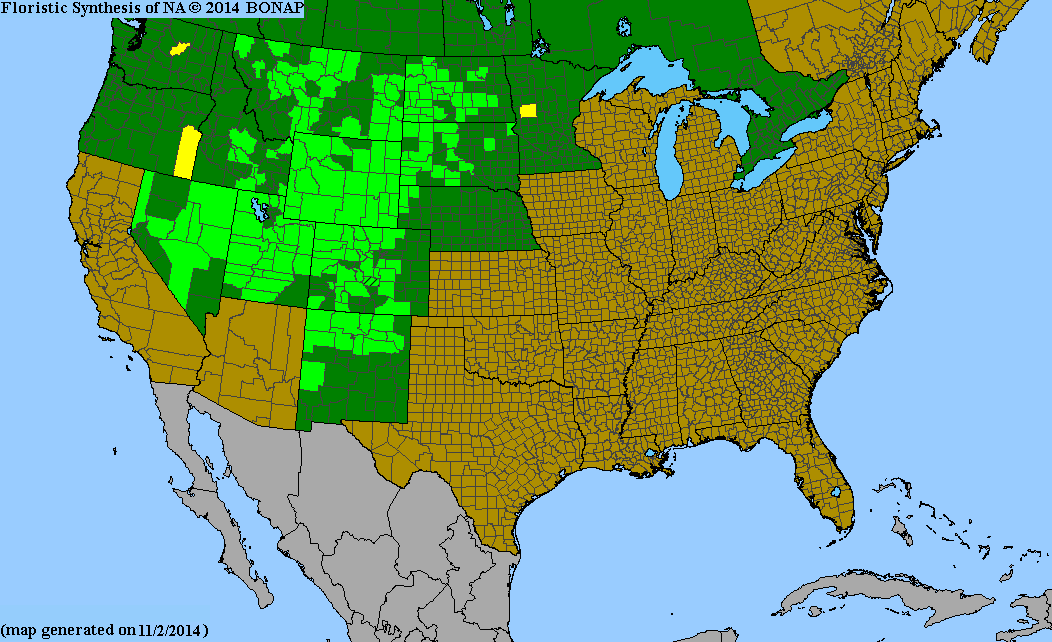
Native Range:

Monarda punctata is known to be native in the shaded areas.

In the short (5 second) video below, you can watch the unique relationship between plant and insect. As the wasp moves from flower to flower, it’s back is dabbed with pollen, which it then spreads to the next flower.

On Native Plant Range Maps 

Have you ever thought about the fact that almost all books on native plants define their ranges as “Native in the Northeastern US and Southern Canada”, or “Native in the Midwest States and Southern Prairies”? Very few plants are native throughout those rather large areas of geography. Soil type, microclimates, even underlying geology can have a great influence on which plants would be found naturally in any given location. Wouldn’t a map be much more accurate and useful? After all, native plant gardeners, more so than any other, want to know if a plant is actually native to where they live. In this month’s article I will try to explain why range maps are not very common, why they are a challenge to create, and why they can be a challenge to interpret.  

There are at least 3 reasons why range maps are rarely found in the guides. The first of these is that, with the exception of a few plants that have been studied extensively (e.g. Goldenrods in the Astereae Lab at the University of Waterloo), a lot of the native plants we want to grow in our gardens have historically garnered very little interest from a geographical perspective. We may have studied the ecology of the plant (how it interacts with its environment), its physiology, and in some cases we may even have brought it into the greenhouse to produce cultivars. But, for the most part, we’ve been more concerned with the plant itself than with knowing where to find it (beyond what kind of soil/light regime it can be found in – prairie, forest, etc.). This means that we just don’t have readily available data to create reliable range maps. 

The second problem is that the collection of locational data to determine native ranges is, by necessity, a historical one. In the past 150-200 years we have moved plants all over the place, well beyond their native ranges. This means that it is a lot trickier now to determine if that plant has always been here, or if it has just escaped from someone’s garden. We rely on early botanists’ recordings of what they saw, and where they saw it.  

However, even though the historical records are extensive, they aren’t always 100% accurate. Modern botanists often debate whether so-and-so’s sighting of this plant or that accurately represent where the plant was found before Europeans arrived. Echinacea purpurea, for instance, is usually considered native in parts of Michigan, but some argue that the historical records indicate it was only found in areas not far from railway corridors. Does this mean those plants were simply the result of seeds brought in inadvertently by rail? Or maybe that their mapped location is a case of the botanists recording those sites, but not venturing further afield to see that the plant existed elsewhere. Keep in mind that at the time many of these botanists were working, there were few roads and lots of wilderness. 

The third, and perhaps biggest challenge, is determining what scale to use to map the ranges. Some maps are created at a small scale (i.e. they cover a large area). By necessity, details get obscured at these scales. If we map, say, the range of Agastache scrophulariifolia (Purple Giant Hyssop) at the North American scale, as shown in the 1945 map from The American Midland Naturalist journal (Vol 33, No. 1), we can see that the mapping is very generalized and doesn’t take into account variations in local landscapes or microclimates. 

At the other end of the spectrum (large-scale mapping), we are zoomed in close (so everything looks larger – hence its name), but these maps have their own issues. Perhaps the biggest of these is that many people looking at such a map believe that the boundary shown is a hard boundary – that the plant is definitely found on one side of the line and not found on the other side of it. Therefore the map-maker runs the risk of using vague data to create the illusion of clear and precise knowledge. As a former map-maker, I know only too well the challenges.  

It is extremely difficult to generate a map showing where a plant was native over a large area and yet still capture small isolated pockets. In the map I created (below) for Green Milkweed (Asclepias viridiflora), you can see that it covers a large contiguous area in a band from southern Lake Michigan, crossing southern Ontario, into Ohio, Pennsylvania and beyond (shown with striped shading). Yet if you look closely, you’ll see a couple of small pockets of stripes – one further north along the Lake Michigan shoreline, and another just north of Manitoulin Island in Ontario. The second of these locations, in particular, is extremely exaggerated in area. In fact, the plants were only found in a small, isolated area that would not even have shown up at the scale of this map. The dilemma is, then, whether to exaggerate the area, or to leave the impression that the plant was never found that far north.  

When you combine all of these reasons, you get a better feel for the amount of work involved to 1. verify the native ranges, and 2. determine what scale to map them at, and what information to include or leave out. All such maps, by necessity, are generalizations because you can’t easily account for small, localized variations. As a result, few people have tried to do it.  

Then, of course, there is the whole business of interpreting the range maps once they ARE made. The authority I use to determine if a plant is native to Ontario is the Database of Vascular Plants of Canada (VASCAN). However, all the maps on their website show nothing more than IF the plant is native SOMEWHERE in Ontario. For instance, Pulse Milk-Vetch (Astragalis tenellus, aka Astragalis multiflorus) is shown as native to Ontario. However, that is based on one, small, localized occurrence in northern Ontario, as shown in this map from the Atlas of Rare Vascular Plants of Ontario. 

South of the border, plant species have been mapped to the county level, in most states. However, it is often unclear if these maps represent current locations or historical (i.e. native) ranges. In the map of the same plant (identified as Astralagus multiflorus) from the Biota of North America Program (BONAP) website, the bright green indicates the counties where the plant is known (in the US) but in Canada that level of mapping has not been done, so the entire province of Ontario is shown in dark green.  This could lead some people to think that it is found throughout the province.  

Before you can decide that a plant is native to where you live, you need to check multiple sources and put together a picture. For those in southwestern Ontario, at least, an excellent resource is Michael Oldham’s 2017 “List of the Vascular Plants of Ontario’s Carolinian Zone (Ecoregion 7E)” that you can download here. It gives a county-by-county breakdown of where the plants are considered to be native. 

Shaun Booth (from In Our Nature) and I have been working on a reference book for native plant gardeners and we have taken on the task of mapping the native ranges for over 200 species of plants in the southern Great Lakes region. Over the past 4 years or so, we have compiled historical records as well as on-line data, and then worked with expert ecologists in the province and adjoining states to verify our maps. We are currently working on finding a publisher so that you, too, can have access to this information. Wish us luck. 

Wild Columbine

I am frequently asked what my “favourite” native plant is. To me, that’s like asking a mother which is her favourite child. But invariably, when asked, Wild Columbine is the first to pop into my mind. I love how it is drought tolerant, produces abundant, easily collected seeds, and has amazing 2 tone flowers. It attracts butterflies, bees and even hummingbirds. And it is, oh, so photogenic. In my garden it grows in full sun to mostly shade and is one of the earliest plants to green up in the spring. (Plant Description and In the Garden sections, below, are courtesy of Shaun Booth of In Our Nature).  

Common Name: Wild Columbine 

Scientific Name: Aquilegia canadensis 

Family: Ranunculaceae (buttercup family) 

Alternate Common Names: Canada Columbine, Cluckies, Common American Columbine, Eastern Red Columbine, Jack-in-trousers, Rock Lily, Wild Red Columbine 

Plant description: Wild Columbine feature light green to blue-green, compound leaves that occur as basal foliage around the base of the plant and as alternating leaves up the flower stems. Each compound leaf is made up of three leaflets, each of which are lobed and measure 6cm long and wide. Nodding flowers, up to 5cm long, are borne on thin, branching stalks that rise above the basal leaves. Flowers are defined by five rolled-up, yellow petals that taper upwards, ending in nectar rich spurs. Dangling yellow stamens (the part that carries the pollen) protrude from the bottom of the flowers. The flowers give way to erect green seed pods that turn brown as they dry and then split open to release shiny black seeds. 

In the Garden: The graceful, nodding flowers of Wild Columbine are a unique and welcomed addition to native plant gardens. This plant is valued by gardeners for a stunning floral display, adaptability and ease of growth. This drought tolerant beauty is a jack of all trades in the garden. It is extremely adaptable to light and moisture conditions as long as drainage is good. 

Skill level: beginner 

Lifespan: short-lived perennial, but self-seeds readily 

Exposure: full sun to full shade, though does best in part shade 

Soil Type: sandy, well-drained soils, not too rich 

Moisture: dry to moist 

Height: 30-90 cm 

Spread: 30-60 cm 

Bloom Period: May, Jun, Jul 

Colour: red or pink and yellow 

Fragrant (Y/N): N 

Showy Fruit (Y/N): N 

Cut Flower (Y/N): Y 

Pests: leaf miner 

The Columbine Leaf Miner leaves squiggly lines in the plant leaves, but these are cosmetic only and do not appear to harm the plant in any way.

Natural Habitat: woodlands and rocky slopes, slopes of deep ravines, steep stream and riverbanks, old-fields 

Wildlife Value: blooms attract hummingbirds, bees, butterflies, and hawk moths while seeds are consumed by finches and buntings. 

Butterfly Larva Host Plant For: Columbine Duskywing (Erynnis lucilius) 

Columbine Duskywing butterfly

USDA Hardiness Zone: 3-8 

Propagation: Most easily propagated by seed sown on the surface in the fall (seeds need light to germinate, so do not cover). If starting indoors, it does best with at least 60 days cold moist stratification. Division of mature plants when not flowering is difficult but possible with care. Young seedlings, however, transplant easily when less than 15 cm (6”) tall and can be a great source of new plants as wild columbine readily self seeds. 

Additional Info: Wild Columbine is a short-lived perennial and will persist by self-seeding into bare soil. 

Book Review: Latin for Gardeners

Book Review: Latin for Gardeners

Book Review 4 – Latin for Gardeners 

I thought I’d approach this book review a little differently. For those who struggle with the botanical names for plants, I’m going to give you some suggestions for useful books and provide some comparisons to help you decide which one (or ones) you might want to acquire.  

A Portable Latin for Gardeners: More than 1500 Essential Plant Names and the Secrets They Contain 

By James Armitage 

  • Publisher: ‎ University of Chicago Press, 2017 
  • Paperback‏:‎ 160 pages 
  • ISBN-10: ‏ 9780226455365 
  • Dimensions: 7.7” X 5.7” 
  • Price: $23.27 (Amazon.ca); $18.00 (Amazon.com) 

and 

Latin for Gardeners: Over 3,000 Plant Names Explained and Explored 

By Lorraine Harrison 

  • Publisher: ‎ University of Chicago Press, 2012 
  • Paperback‏:‎ 224 pages 
  • ISBN-10: 022600919X 
  • Dimensions: 6.4” X 9.1” 
  • Price: $31.94 (Amazon.ca); $25.00 (Amazon.com) – hardcover 

Either of these books would be a great addition to your library. Although written by different authors 5 years apart, they were both published by University of Chicago Press and so they are very similar in content and layout. 

Of the two, I prefer the second one, even though it’s a bit pricier. Not only does it contain twice as many terms, but it is hardcover and comes with a ribbon attached to the spine that can be used as a bookmark. The Portable Latin also has a built-in bookmarker, but it is an elastic attached to the back cover that, although it does the job, is not as easy to use. It is a very sturdy cover, for a paperback, and seems very well constructed and durable. 

Both books are beautifully illustrated with artistic renderings of plants, and the larger Latin for Gardeners also contains one- and two-page inserts throughout that highlight various genera of plants (20 of them), discuss the people who hunted for and discovered plants (10 of them), and other, assorted “Plant Themes” (7 of them). It also has a number of ¼ page inserts, titled Latin in Action, that include a drawing of a plant and discuss some of its attributes or how it can be used in the garden. 

The terms listed in Latin for Gardeners are listed in alphabetic order, from “a-“ (used in compound words to denote without or contrary to) to “zonatus” (with bands, often colored, as in Cryptanthus zonatus). The Portable Latin breaks the book down into sections based on the characteristics the terms refer to, then lists the terms in alphabetic order within each section. This necessitates the use of an index to find words, but it also makes for a much more interesting read, and in some ways, more educational and informative. 

The sections in A Portable Latin are “Color”, “Plant Form”, “Features of Plants”, “Comparisons”, “Places and People”, and “Ideas, Associations, and Properties”. Within each of these categories are subcategories. For example, the section “Color” is further divided into “Light Colors” (e.g. albiflorus, albiflora, albiflorum With white flowers, as in Buddleja albiflora), “Bright Colors” (e.g. fucatus, fucata, fucatum Painted; dyed, as in Crocosmia fucata) and “Dark Colors and Multicolors” (e.g. purpurascens Becoming purple, as in Clianthus purpurascens). 

Both books will help you better understand the botanical names that we often struggle with. And even though 3,000 terms seems like a lot, there are many terms I encounter regularly when working with native plants that don’t show up in either book, such as oolentangiense (as in Symphyotrichum oolentangiense, Sky Blue Aster) or prinoides (as in Quercus prinoides, Dwarf Chinquapin Oak). 

A similar book that just arrived in the mail this week (I found a good used copy online through Thrift Books in the US for under $8) is  

A Gardener’s Handbook of Plant Names: Their Meanings and Origins 

By A. W. Smith 

  • Publisher: ‎ Dover Publications, 1997 (reprint of original 1963 version)  
  • Paperback‏:‎ 448 pages 
  • ISBN-10: 0486297152 
  • Dimensions: 5.4” X 8.54” 
  • Price: $25.12 (Amazon.ca); $16.68 (Amazon.com) 

This book contains no pictures of any kind, but it has a lot more terms defined than the other two (alas, it doesn’t include oolentangiense or prinoides, either). In my research for this review, I couldn’t find out exactly how many terms, but it does include some other interesting things, as well. One of these is a table of 1800 common plant names and their corresponding botanical ones. Whereas the first two books only list terms that are used in the specific epithet (species name), this book also includes the terms used in the generic names (e.g. Asclepias for milkweed). It also gives a much more detailed description of how the Latinized words are used and pronounced for botanical names, and points out some of the exceptions that tend to throw us for a loop when we think we finally have it figured out.  

Any of these books would be useful, and it depends on what you are looking for. The artwork in the first two books make them wonderful books just to read through, but the dictionary-like structure of the third one, as well as the extra information contained within it, makes the third book a bit more practical.  

Or, you could do like I did, and get all three. 

Happy native plant gardening. 

Are My Plant Seeds Native Enough? 

There’s a lot of activity on the various native plant gardening Facebook groups these days about winter sowing.  I’ve never tried it, but it makes total sense to do what Mother Nature does – set your trays of soil with seeds outside and let the natural refrigeration of winter do the cold moist stratification for you. 

In my research for native plants sources, I have come across a handful of companies that specialize in native plant seeds. In fact, some ONLY sell seeds and not plants. 

Have you ever asked yourself where they get the seeds? Does it even matter? A milkweed is a milkweed, regardless of where it is growing, is it not? Well, that depends. 

Rare Native Plants 

In southwestern Ontario, where I live, we are in what is often referred to as the Carolinian Life Zone. Here our climate and soils are similar to places far south of us – as far as the Carolinas in the US. That means that many plants are native here that aren’t found naturally anywhere else in Canada.  It also means we’re at the northern limit for many of these plants, and occasionally the populations of these plants are found only in isolated pockets here and there.  

Take, for example, Stylophorum diphyllum, or Wood Poppy, known to be found naturally only in a few isolated locations around London, Ontario before we started spreading it through our gardens.  

Or what about Cercis canadensis, the Eastern Redbud, a beautiful small tree originally known only from Pelee Island in Lake Erie (Canada’s most southerly point – at the same latitude as northern California). However, because of it’s size and spectacular spring colour it now adorns many yards throughout southwestern Ontario and even points north and east of here. 

Two Sides to the Argument 

There are two sides to the argument about whether this is a good idea or not, and I still haven’t entirely made up my mind which side I’m on. Both sides have much merit. 

The first argument is that these isolated pockets may hold unique genetic traits that could disappear though cross-breeding with plants that evolved elsewhere. And until we have done genetic testing to show otherwise, we should not introduce these other plants. To loosely paraphrase Joni Mitchell, “We won’t know what we’ve lost if it’s gone”. 

At the other end of the spectrum, there is the argument that rare, isolated pockets of such plants are in danger of being lost due to habitat destruction, climate change, pollution, etc. and that in order to keep seeing them, we need to plant more. After all, humans are the main reason many have disappeared over the last 200 years, or are on the brink of disappearing now. And since there are so few left in the wild here, we need to source the seeds elsewhere.  

The other argument for bringing seeds or plants in from other areas is that very small, isolated pockets of plants may reach a genetic bottleneck where inbreeding can lead to weakened plants that are more susceptible to the stressors that are placed on them. Only by bringing in outside plants can we bolster the genetic diversity and, hopefully, stave off extinction.  

Native Plant Sources – Choices 

I recently placed an order for some seeds from a company in Ontario because they were the only company offering the plant I have been looking for for some time. I was told the seeds for my plant were ethically sourced in Ontario.  

However, for another plant I was curious about, I was informed the seeds were from the US. They ignored my question about WHERE in the US, but my guess is that it was likely Prairie Moon Nursery in Minnesota as that is one of the larger sources of native plants seeds and many nurseries here in Ontario use seeds from there.  

The latitude of Minnesota is roughly the same as southern Ontario so those plants should be hardy here. However, the original stock from which those seeds were sourced may be genetically quite different than the ones that actually evolved here. It has been reported that Asclepias tuberosa – butterfly milkweed – plants tend to be a lighter yellow in the west and a darker orange in the east. By the same token, Ratibida columnifera (not actually native in Ontario) – sometimes called Mexican Hat – is mostly pure yellow in Canada but mostly a burnt red in the southern end of its range. By bringing in different genetics, we may lose the plants that have evolved here, and any uniqueness they offer. 

Another native Ontario plant from my wish list that this company offered for sale was out of stock. I was shocked, though, when they said they were just waiting on their shipment from England. What? A native Ontario plant and it is being sourced from across the ocean?  

A few years ago, someone told me that seeds for a plant I was looking for was available on Amazon. After doing a bit of digging, I discovered that these seeds were “shipped from China”. I didn’t buy them.  

All of this is to say, whether you’re winter sowing or spring sowing, ASK where your seeds came from. If there just AREN’T any seeds or plants available for that one plant you really MUST have, only you can decide what limits you’ll set on the acceptable distance from where you live to where they are sourced from. As the demand for native plants continues to grow, local sources will continue to pop up. If they know that the provenance of the seeds is important to native plant gardeners, they will look closer to home to source their seeds. And eventually (I hope) more local farm operations will start to grow native plants to supply the market with seeds. 

In the photo below, the Irvine Ranch Conservancy in California is one of many commercial native-plant producers in the US (photo courtesy of Irvine Ranch Conservancy). I was unable to get a photo from a local commercial producer in time for posting. This level of production is possible here, too, and will happen if we demand local seeds.

Happy native plant gardening. 

Allium Cernuum

This month’s plant is a member of the Allium family noted for its beautiful clusters of pink flowers in mid to late summer that attracts pollinators from far and wide. As a member of the onion family, the tender young stems can be used where you would use chives and the bulbs can be used raw or cooked – though they have a very strong flavour.  The Plant Description and In the Garden sections, below, provided by Shaun Booth of In Our Nature. 

Common Name: Nodding Wild Onion 

Scientific Name: Allium cernuum 

Family: Liliaceae (lily family) 

Alternate Common Names: Lady’s Leek, Nodding Pink Onion 

Plant description: Nodding Onion features a tuft of basal leaves originating from a bulb. It’s arching, grass-like leaves reach up to 30cm long and 1cm wide. The leafless flower stalks rise slightly above the foliage and bend downwards at the top, producing a nodding umbel of flowers (hence the name “Nodding” Onion). All parts have a strong onion smell. 

In the Garden: Nodding onion is a small but showy plant that thrives in tough sites. For best effect, plant it in large groupings. It doesn’t like competition from taller plants so plant accordingly. This is a very well-behaved, clumping plant but may self-seed in optimal conditions. 

Lifespan: perennial 

Exposure: part shade to full sun 

Soil Type: humus-rich, neutral to alkaline soils but will adapt to acidity, sand to clay 

Moisture: medium dry to moist 

Height: 40 cm 

Spread: 8-15 cm 

Bloom Period: Jun, Jul, Aug 

Colour: pink (white) to light lavender 

Fragrant: (Y/N): Y (leaves produce an onion-like scent when crushed) 

Showy Fruit (Y/N): N 

Cut Flower (Y/N): N 

Pests: no serious insect or disease problems 

Natural Habitat: prairies, rocky outcrops and at the edge of dry open woodlands 

Wildlife Value: supports a variety of generalist pollinators including native bees and the nectar attracts hummingbirds and butterflies 

Butterfly Larva Host Plant For: Hairstreak butterflies (Satyrium spp.) 

Banded Hairstreak caterpillars feed on Allium Cernuum leavs and flowers.

USDA Hardiness Zone: 3-8 

Propagation: Spreads by seed and bulb offshoots. Sow seeds in the fall or provide 60 days moist, cold stratification if spring planting. Cover lightly with soil/growing medium. Plants benefit from being divided every third year or when 8-10 bulbs appear in the clump. Plants may be divided any time of the year. 

Additional Info: Walnut (juglone) tolerant. Nodding Wild Onion is rare in Ontario – it is believed that the only natural populations left are those growing in alvar habitat on Pelee Island. In New York it is classified as Threatened. 

A Garden for the Rusty-patched Bumblebee: Creating Habitat for Native Pollinators 

A Garden for the Rusty-patched Bumblebee: Creating Habitat for Native Pollinators 

A Garden for the Rusty-patched Bumblebee: Creating Habitat for Native Pollinators 

By Lorraine Johnson and Sheila Colla with illustrations by Ann Sanderson 

  • Publisher: ‎Douglas & McIntyre, 2022 
  • Paperback‏:‎ 256 pages 
  • ISBN-10: ‏ 1771623233 
  • Dimensions: 7.9” X 9.2” 
  • Price: $22.95 (Amazon.ca); (currently not available on Amazon.com) 

I am a long-time fan of Lorraine Johnson’s native plant gardening books. 100 Easy-to-Grow Native Plants for Canadian Gardens, Grow Wild: Native-Plant Gardening in Canada and Northern United States, and The New Ontario Naturalized Garden are some of the first books I bought on the topic when I started down the path of growing native plants. All of those books were informative and helpful on my journey. However, A Garden for the Rusty-patched Bumblebee is a giant step up from those, in my opinion.  

First off, in the introductory chapters, the authors carefully build the argument for growing native plants in our gardens and they tackle the sometimes contentious issues of cultivars, raising honeybees, and the myth of the value of city green-spaces (at least as they are currently manifested). They share important information on the differences between many of our pollinators – solitary bees, bumblebees, various specialist bees and their critical needs, as well as on other insects that are pollinators. They also discuss the reasons why we need to “leave the leaves” and otherwise ensure that these pollinators, be they bees, moths, butterflies or beetles, have suitable overwintering habitat. 

But what I like best are the plant descriptions. These are placed in alphabetic order by scientific name (which, if you’ve read any of my blog articles, you’ll know I’m adamant about) and divided into season of blooming (spring, summer, fall). Each plant description includes height, colour, growing needs, and a short blurb about the plant. I especially like the “Specialist relationships” and “Good companions” sections for the plants. And each plant has either a photograph or one of Ann Sanderson’s beautiful and accurate drawings. 

But our perennial herbaceous flowers aren’t the only things that need pollinators and vice-versa. So there is a section on Grasses and Sedges that are important food sources for many pollinating insects, and there is also a section on Trees, Shrubs and Woody Vines. 

The book then wraps up with a discussion of rain gardens, boulevard gardens, some sample garden designs, and a list of resources.  

As the current native plant “guru”, Dr. Douglas Tallamy, stated in a recent webinar (I’m paraphrasing here) – if you only buy one book on native plant gardening, this is all you’ll need. 

Happy native plant gardening. 

© The Native Plant Gardener 2022