The Rain Garden – Part 2: Plant Choices 

Last month’s article “It’s Raining, It’s Pouring, My Garden is Growing” discussed the how and why to build a rain garden. In this month’s article I will share some of my favourite plants that are well suited to rain gardens. These plants can handle both having their feet wet on occasion, sometimes for days on end, yet can also tolerate long periods of dry soil.  

The following plants are listed in alphabetical order by scientific name. Plants with hyperlink are ones that have a complete description on the Plant of the Month pages of this website. 

The Sunny (to partly sunny) Rain Garden 

Perennials 

Swamp Milkweed (Asclepias incarnata) – 3′ to 4’ tall, a monarch host plant and an excellent nectar source for butterflies and even hummingbirds. The juice of this wetland milkweed is less milky than that of other species. It tends to bloom twice in a growing season when in gardens. Rare occasional white specimens are found in the wild and these have led to cultivars such as “Ice Ballet.” 

Marsh Marigold (Caltha palustris) – up to 18″ tall, this is one of the first wetland flowers to bloom in spring. Seeds should be sown as soon as they’re ripe and cannot dry out before sowing. Seedlings do not flower until the third year following germination. Plants also reproduce easily by division in early spring as the plants are emerging. 

Boneset (Eupatorium perfoliatum) 3′ to 4′ tall, has very distinct, bold leaves with a crinkly texture and the pure white flowers bloom for a long time. Nectar or and pollen of the flowers attracts many kinds of insects and it is a host plant for several moth species. Seeds need light to germinate in the fall, and sow thickly as germination rates are typically low. Stratification for at least 30 days will increase germination percentages. Seeds will last up to 3 three years if stored in the fridge. Boneset can also be propagated by root division in the fall just as they go dormant, or in early spring just as the first shoots appear 

Joe-Pye Weed (Eutrochium maculatum) 5′ to 7′ tall, the flowers have a light vanilla fragrance that becomes more intense when crushed. An important food source for butterflies, bumblebees, green metallic sweat bees, and skippers, it is also the host plant for several moth species, including the Ruby Tiger Moth. 

Bottle Gentian (Gentiana andrewsii) 1′ tall, it is especially valuable to bumble bees, just about the only insect with enough strength to force its way into the closed flower. Plant tends to lean at maturity, so plant among sturdier plants for support. If left undisturbed, plants in optimum growing conditions will naturalize over time into large clumps. 

Water Avens (Geum rivale) 1’ to 2’ tall, the intricate, droopy flowers of Water Avens will add a touch of elegance to your garden and are best enjoyed up close. They provide a long bloom time and turn into ornamental, fluffy seed heads. Water Avens maintains a clumping form and looks its best when planted en masse. The fragrant flowers were once used to flavour ales, and the roots can be boiled to make a chocolate-like drink.  

Spotted Jewelweed (Impatiens capensis) AKA “touch me not”, this plant will get up to 5’ or more in height and will eagerly self-seed and quickly cover moist areas with beauty and wildlife value.  Hummingbirds and butterflies seek nectar, and several native bees (listed by the Xerces society as of special value to bumblebees) collect pollen (it is listed by the Xerces Society as of special value to bumblebees). The juice from Jewelweed stems contains a compound called lawsone, which has shown to have antihistamine and anti-inflammatory properties. It is said to relieve itching from Poison Ivy, mosquito bites, and Stinging Nettle and has also been used to treat athlete’s foot. 

Blue Flag Iris (Iris versicolor) At 2’ to 3’ tall, this is a personal favourite of mine. Seeds require at least 4 months of cold, moist stratification to germinate and will take 2 years till they produce flowers. To propagate vegetatively, the roots can be divided in early summer. 

Cardinal Flower (Lobelia cardinalis) 3′ to 4’ tall, this is a hummingbird magnet in the garden. Although relatively short lived (usually 2-3 years) it can carry on in your garden by dividing it or moving it every year or two. This plant is at its finest when growing with minimal competition in forested wetlands. Note that commercial garden centers often sell cultivars of this plant, that may or may not be as valuable to wildlife as the true species. 

Blue lobelia (Lobelia siphilitica) 2’ to 4’ tall, the nectar attracts butterflies and native bees and occasionally hummingbirds. Pinch back the plants to make them bushier. Blue Lobelia will produce offsets around the base that will generate their own roots. These can be removed with a sharp knife in the spring or fall, being careful to retain their roots, and transplanted. These small offsets are delicate, so care should be taken not to bury them under thick mulch. 

Monkey Flower (Mimulus ringens) 1’ to 3’ tall, adds a wonderful, refined look to wet sites and will spread slowly by rhizomes to take on a bushy look once mature. Its snapdragon-like flowers have a long bloom time, which is great for bees and gardeners alike. The dried seed heads provide great textural interest over the winter months. 

Golden Grounsel (Packera aurea) 1′ to 2’ tall, it puts on a luminous and long-lasting display of golden- yellow flowers in the springtime. It is a robust, bold- textured groundcover that will spread by both rhizomes and seeds. 

New England Aster (Symphyotrichum novae-angliae) 3′ to 5′, this is a host plant for Checkerspot and Crescent butterflies and others, and for several moth species. New England Aster has a tendency to become root-bound and will benefit from dividing the plant every 3 to 4 years. Pinching back the stems a few times before mid-July will help to make the plant bushier and eliminate the need for staking. 

Blue Vervain (Verbena hastata) up to 5′ tall, it puts on a majestic display of candelabra-shaped flower clusters in mid-summer, filling the garden with accents of violet-blue. It maintains a clumping habit and makes a great structural plant. The rigid stems and seed heads stand tall through the winter to provide excellent seasonal interest. 

Shrubs 

Buttonbush (Cephalanthus occidentalis) 5’ to 10’ tall, this shrub produces a unique white round flower head that is highly attractive to bees and butterflies. It can be pruned back in the spring if necessary. The shrub requires full sun but may tolerate some shade. Otherwise, buttonbush is extremely resilient in all types of temperatures and conditions. It is important to note that the leaves of this plant are toxic to humans. 

Meadowsweet (Spiraea alba) 3′ to 6’ tall, larval host for Spring Azure butterflies. Blooming for 1 to months, the pollen and nectar attract a wide range of bees, bumblebees, moths and other pollinators. It takes well to pruning after flowers have finished blooming. It does spread by rhizomes and may work better in a larger rain garden. 

The Shady Rain Garden 

Perennials 

Yellow Lady’s Slipper (Cypripedium parviflorum) 1’ to 2’ tall, propagating these showy yellow orchids from seed is complex. The seeds are extremely small and contain no endosperm (the energy reserves in most other seeds) and cannot survive without a symbiont soil fungus to absorb nutrients for it. Most commercially grown Lady’s Slippers are germinated in the lab in a special medium, or by tissue culture, can take a year or more to germinate, and up to a decade or more before they flower. This is why lady’s slipper orchids are so expensive. If someone is selling you a Cypripedium orchid at a bargain price, chances are it was wild harvested. In the garden, plants that have grown very large (with at least 30 shoots) should be divided to keep the plant healthy. 

Virginia Waterleaf (Hydrophyllum virginianum) 1’ to 2’ tall, is a reliable ground cover that puts on a verdant display of leaves early in the spring. Delicate -looking flower clusters rise above the leaves in late spring to dot the landscape with pastel purple hues. 

Wood Lily (Lilium philadelphicum) 2’ to 3’ (occasionally up to 4’) tall, the stunning flowers add fiery red/orange accents to the summer garden, while its whorled leaves add an interesting texture. It has a very elegant look overall and maintains a clumping habit. Pair it with plants of similar height as it does not like competition. It’s slow to establish but well worth the wait. 

Cardinal Flower (Lobelia cardinalis) – see above 

Royal Fern (Osmunda spectabilis formerly O. regalis) 3’ to 6′, it is one of the largest ferns in non-tropical North America. Fronds typically turn yellow to brown in autumn. Spores are located in brown, tassel-like, fertile clusters at the tips of the fronds, thus giving rise to the additional common name of flowering fern for this plant. 

Golden groundsel (Packera aurea) – see above 

Marsh Fern (Thelypteris palustris) 1’ to 2’ tall, this fern spreads to form a lush green ground cover in moist soil. Although it does well in sunnier rain gardens, it also thrives in moderately dense shade in my gardens.  The Marsh Fern often forms dense colonies of leaves, it provides good cover for the smaller kinds of wildlife.  

Shrubs 

Witch-hazel (Hamamelis virginiana) 8′ to 20′ tall, it prefers moist, acidic, organically rich soils and will tolerate heavy clay soils. One of the last shrubs to flower. the stem-hugging clusters of fragrant bright yellow flowers, each with four crinkly, ribbon-shaped petals, appear along the branches from October to December. 

Northern spicebush (Lindera benzoin) 4’ to 15′, this fragrant (spicy) host plant for the Spicebush Swallowtail butterfly produces beautiful, tiny yellow flowers in the spring and makes a great alternative to the non-native Forsythia. Shrubs are either male or female, and if you’re lucky enough to get a female, you are apt to get bright red, spicy smelling fruit in late summer. In the fall, the leaves are brilliant  yellow.  

Lobelia cardinalis

Cardinal Flower 

The last “Plant of the Month” for 2023. Since we really don’t have any native plants blooming at Christmas (other than, perhaps, Hamamelis virginiana – American Witch Hazel), I thought I’d do the next best thing and at least pick a plant that has “Christmas colour”. For that I chose the nice, cheery reds of Lobelia cardinalis, Cardinal Flower. 

This moisture loving, short lived perennial is a an essential rain garden or pond addition, and is sure to draw hummingbirds to your yard as it is one of their favourites (at least in my yard it is).  

As usual, the Plant Description and the In the Garden sections below are courtesy of Shaun Booth. 

Happy Native Plant Gardening! 

Common Name: Cardinal Flower 

Scientific Name: Lobelia cardinalis 

Family: Campanulaceae (Bellflower Family) 

Alternate Common Names: Indian Pink 

Plant Description: Cardinal Flower has an unbranched central stem that is light green and variably hairy. Leaves are attached to the stem in an alternate pattern and are up to 15 cm long and 4 cm wide but usually only get to half this size. The lower leaves have short stalks while the upper leaves are stalkless. Each leaf is coarsely toothed, sharply pointed, and usually hairless. Stems terminate with spike-like clusters of tubular, ascending red flowers, each measuring up to 4 cm long and 2.5 cm wide. The upper lip of each flower has two lobes that spread out sideways while the lower lip is divided into three lobes. A red style with a hooked tip rises above the upper lobes. Flowers turn into small capsules containing many tiny seeds. 

In the Garden: Cardinal Flower is nothing short of a showstopper! In midsummer it sends up magnificent spikes of scarlet red flowers that add a strong vertical presence to the landscape. Fortunately, herbivores tend to avoid this plant. 

Skill Level: Beginner to intermediate 

Lifespan: Short-lived perennial 

Exposure: Full sun to full shade (but does best in part shade) 

Soil Type: Clay to sandy, limestone-based soil and humus-rich soil 

Moisture: Moist to wet (needs constant moisture to thrive) 

Height: 30–120 cm 

Spread: 30–60 cm 

Bloom Period: Jul, Aug, Sep 

Colour: Red 

Fragrant (Y/N):

Showy Fruit (Y/N):

Cut Flower (Y/N):

Pests: No serious insect or disease problems, though snails and slugs may munch on the leaves 

Natural Habitat: Wet ditches and other low damp areas, seasonally inundated depressions in open woodlands, and along streambanks 

Wildlife Value: An important nectar source for hummingbirds and swallowtail butterflies (Papilionidae

A favourite of the ruby throated hummingbird.

Butterfly Larva Host Plant For: None 

Moth Larva Host Plant For: Pink-washed Looper Moth (Enigmogramma basigera

USDA Hardiness Zones: 3–9 

Propagation: Surface sow as the very tiny seeds need light to break dormancy. Seeds require 60 days of cold, moist stratification to germinate if starting indoors or spring sowing. Surface sow in the fall. Basal offsets may be separated to start new plants. Plants may also be started by taking stem cuttings (be sure to include one or two nodes), but to ensure the plants have developed a good basal rosette, the earlier these cuttings are taken in the season, the better. New plants may also be propagated by layering; in midsummer, carefully bend the plant over and pin it to the ground, lightly covering the plant with soil. New roots will grow along the stem and new shoots will emerge, which can be transplanted in the fall. 

The very fine, almost powder like, seeds of Lobelia cardinalis require light to germinate.

Additional Info: Though this short-lived perennial typically only lives for two to three years, it can carry on in your garden by dividing it or moving it every year or two. This plant is at its finest when growing with minimal competition in forested wetlands. Note that commercial garden centres often sell cultivars of this plant that may or may not be as valuable to wildlife as the true species. 

Native Range: 

Cardinal flower can be found throughout the southern Great Lakes region, wherever soils are moist enough.

It’s Raining, It’s Pouring, My Garden is Growing 

Designing a Rain Garden 

Most yards, whether urban or rural, are high and dry – and for good reason. No one wants to walk around on a sloppy, muddy lawn each time it rains.

During a heavy downpour, lawns can sometimes get pretty soggy.

However, such lawns limit the species we can grow to those that don’t require a lot of water, and we have many beautiful native plants that actually appreciate having their “feet wet”, at least occasionally.  At the same time, our rooftops collect gallons of water every time it rains, and often the water is diverted to sewers or ditches, or simply directed onto the lawn. A solution to both these problems is the rain garden. 

What is a Rain Garden 

In its most basic form, a rain garden is a depression in the lawn where water from downspouts is directed each time it rains and in which we plant some water-loving plants. But to be truly effective, the garden needs to be designed to match your soil type and the amount of rain collected from the roof, otherwise you could end up with a mud patch that never dries, or a garden that gets a flush of rain once in a while but soon dries up. And although there are plants that will survive either of these scenarios, a properly designed rain garden will offer a long term, beautiful garden solution. 

This month’s article is on how to design and build such a rain garden. 

The Four Main Considerations – Water, Soil, Calculating the Area, and Plants 

Part 1 – How Much Water Do I Have? 

Calculating how much water you can collect from your roof is actually pretty straightforward (more so when using metric measurements – but I’ll give the formulae for both). A good rain gauge and some long term records are best for accuracy, but you may be able to get enough information from the weather reports. But designing your garden properly requires knowing how much rain you’re apt to get in the growing season, and for this you need historical records.  

In Canada, you can look up historical normal rainfall through Environment Canada’s Website at https://climate.weather.gc.ca/climate_normals/station_select_1981_2010_e.html?searchType=stnProv&lstProvince=ON and simply select your city (or a nearby city, if it doesn’t have data for your town). 

In the USA, try https://www.currentresults.com/Weather/US/average-annual-precipitation-by-city.php  

Once you’ve found what your normal rainfall amounts are (by month is ideal), then you need to know how much of that rainfall your roof is collecting. (If you know of a source of the historical maximum rainfall amounts in various locations across the country, please let me know.) 

Calculating Potential Rain Capture 

Calculating the amount of rain your roof captures is the easy part (sort of). A simple method is to measure the dimensions of your house, then divide it into sections that are captured at each downspout.

For instance, my house is a small wartime bungalow, approximately 9.2 m X 8.6 m or (very roughly) about 80m2 of roof area (about 30’ X 28’ = 840 sq ft). There are two downspouts, one on each side, each collecting from 40m2 (420 sq ft) of surface area. (We’re not interested in the actual surface area, but instead just the area that intercepts rainfall.) If you don’t know the dimensions of your house, you can use Google maps (satellite view) to measure the area. 

Metric and Imperial dimensions of my house, indicating approximate area collecting rainfall at each downspout.

If you’re using metric measurements, it’s simply the area in square meters multiplied by the rainfall amount in mm. This gives you the volume of rainfall in litres.  

If you’re still using imperial measurements, the formula is roof area in sq ft x the rainfall in inches x 0.623m, which provides you with the total (US) gallons of water (to convert to imperial gallons, multiply by 0.83). 

In the example of my house, a 25 mm (1”) rainfall event will collect: 

25 mm X 40 m2 = 1000 L of water (or 1” X 420 sq ft X 0.623 = 261.7 US gal) 

(to convert to imperial gallons: 261.7 US gal X 0.83 = 217.2 Imp gal) 

Part 2 – Determine Your Soil Type 

You’ll also need to have an idea of your soil type. Clay soils will need a larger garden than sandy soils because clay does not drain as readily (we’re not building a pond – we actually want the water to soak in and drain away through the soil so that it doesn’t become a mosquito hatchery). There is an excellent article on how to determine your soil type at https://www.rhs.org.uk/soil-composts-mulches/soil-types. Another, slightly more detailed and technical article, can be found at https://www.gardeners.com/how-to/what-type-of-soil-do-you-have/9120.html.  

Once you know your soil type we can put all this information together to calculate the size of your rain garden.  

Building the Right Size Rain Garden in the Right Place 

If your garden is too small for the amount of rain you are apt to get, it will overflow into the lawn. If it’s too big, your plants may not get enough moisture.  

Also, your rain garden should be at least 3 m (10’) from the foundation. If it’s too close to the house, you could end up with a wet basement.  

Large rain gardens will take more time to maintain and money to complete but will be more effective for capturing runoff. However, relatively small rain gardens can still capture stormwater and improve water quality.  

Part 3 – Calculating Area 

Typically, residential rain gardens are between 10 to 30 square metres (100 to 300 square feet) and 10 to 20 centimetres (4 to 8 inches) deep. However, to maximize the efficiency of rainwater use, the surface area of your garden should be about 20% (for sandy soil) up to 45% (for clay soil) of the cumulative drainage area (that area of the roof feeding the downspout going to your rain garden). Note that these percentages are simply a guideline – in fact many sources indicate widely different values – anywhere from 10-20% (sand to clay) all the way to 20-65% (sandy to clayey). These percentages are referred to as the “Soil Factor”. 

Soil Factor table.

Therefore, in my example above, if I am collecting rain from just one downspout and using my suggested Soil Factors, my rain garden should ideally be: 

Sandy soil:  40 m2 X 0.20 = 8 m2 (420 sq ft X 0.20 = 84 sq ft).  

Loam soil:  40 m2 X 0.30 = 12 m2 (420 sq ft X 0.30 = 126 sq ft). 

Heavy clay soil: 40 m2 X 0.45 = 18 m2 (420 sq ft X 0.45 = 189 sq ft). 

And if your rain garden is more than 10 m (30’) from your downspout, you will need to factor in the surface area of lawn and driveway, etc. that are also feeding into the garden.  

What if My Lawn has a Slope? 

It is important to keep the garden level for optimal filtration so if your lawn is sloped, you may need to do some “cut and fill” (removing soil at the high end and spreading it to the lower end – possibly adding a berm to retain water). 

The slope of your lawn should determine the depth of your rain garden and the slope can be determined by following these steps: 

  1. Place one stake at the uphill end of the rain garden site and place the other stake at the downhill end. The stakes should be approximately  4.5 metres (15 feet) apart. 
  1. Tie a string to the bottom of the uphill stake and run it to the downhill stake. 
  1. Using a carpenter’s level, make the string horizontal and tie it to the downhill stake at that height. 
  1. Measure the width between the two stakes. 
  1. Measure the height on the downhill stake from the ground to the string. 
  1. To find the lawn’s percent slope, divide the height by the width and multiply the result by 100. 

How Deep Should the Garden Depression Be? 

• If the slope is less than 4%, build a rain garden that is approximately 7 to 14 centimetres (3-6 inches) deep. 

• If the slope is 5-7%, build a rain garden that is approximately 15 to 18 centimetres (6-7 inches) deep. 

• If the slope is 8-12%, build a rain garden that is approximately 20 centimetres (8 inches) deep. 

Laying Out the Rain Garden 

Finally, you must determine the design of your rain garden. To do this, simply choose a garden width that best suits your property and landscaping. Next, divide the surface area of your garden by the garden width to determine the garden’s length. As for shape, crescent, kidney and teardrop shaped gardens can be quite attractive. 

If your proposed garden isn’t a simple rectangle, and you’re not sure how to determine the area, there’s an excellent tutorial at https://www.hollandbulbfarms.com/garden-area-calculator and a more technical approach at https://www.youtube.com/watch?v=Rogg7stSj6c

Getting Water Into and Out of the Garden 

Finally, some consideration about the inlet and outlet to your rain garden. If your downspout empties directly into the garden, you’re set at that end. If you don’t want the downspout running across your lawn, you may decide to make a dry streambed of river stone between the downspout and garden for an added feature, bury some Big-O pipe in the lawn, or simply create a grassed shallow channel. In this last case, it can be helpful to add a few stones at the garden entry area to slow the water flow for days of heavy rain to prevent erosion. 

In periods of torrential rain, the rain garden may overflow. If your lawn is sloped, you’ll want to create a low, stone-reinforced exit so that the berm doesn’t get washed away.  

A Note of Caution on Mulching Your Rain Garden 

Many of us like to use wood chips or other mulch on our flowerbeds. Keep in mind that after a heavy downpour, wood chips and many other mulches will likely float to the top and may overflow onto your lawn. If you need to use a mulch, consider stone or other heavy substance.  

Next Month – Part 4 – Plants for a Rain Garden 

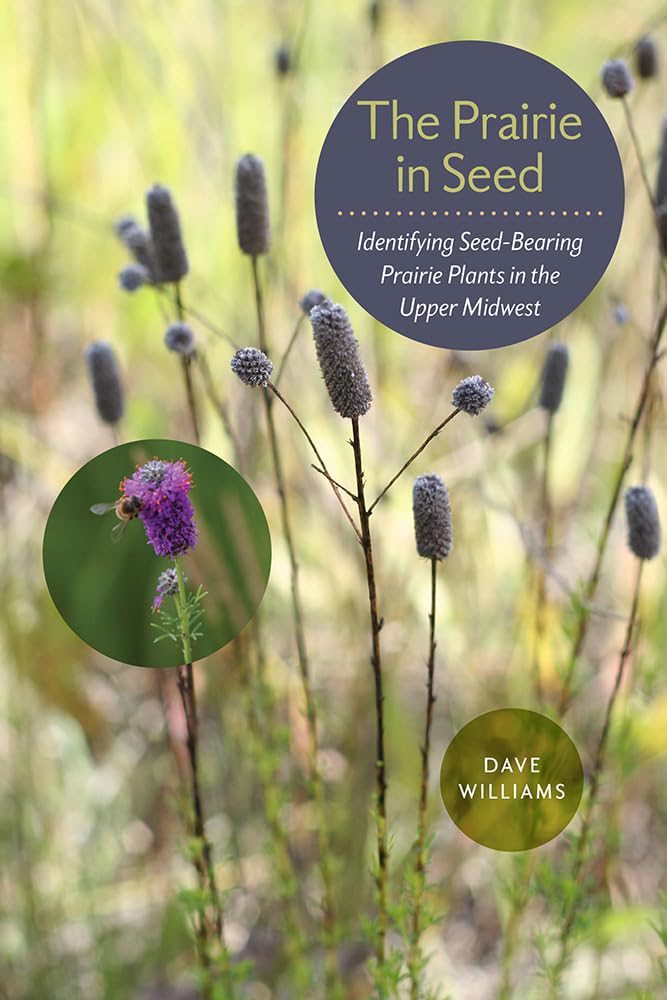
Book Review – The Tallgrass Prairie Center Guide to Seed and Seedling Identification in the Upper Midwest 

By Dave Williams and Brent Butler 

  • Publisher: ‎University od Iowa Press, 2010 
  • Paperback‏:‎ 138 pages 
  • ISBN-10: 158729902 
  • Dimensions: 6.13” X 9.25” 
  • Price: $19.21 (Amazon.ca); $14.00 (Amazon.com) 

For the serious grower of Native Plants. And for the beginner, too. If you are growing native tallgrass prairie species in a greenhouse, are winter sowing, or if you just want to know if you should pull that weed or leave it, this book is excellent. The authors grew a number of forbs and grasses in the greenhouse for several weeks and photographed them at various stages. They then point out the key characteristics at each stage of development. They provide photos of the seeds, too. All pictures are clear and unambiguous and the descriptors include germination and growth notes, as well as a section on look-alikes.  

The book is broken down into two main parts – Forbs Identification Guide, and Grasses Identification Guide. The Forbs section is further subdivided into 7 groups based on key characteristics, the Grasses section into 4 groups. The authors state “Associated with each group is a line drawing of a seedling with its most important parts highlighted. Remember those parts, because seedling identification is nothing more than finding them – or not finding them – in a key. Seedlings are therefore grouped by their key characteristics, not by their species or in alphabetical order.” 

This is an excellent guide. And although it is for the Upper Midwest (US), most of the plants are native in the southern Great Lakes Region, too. This should prove to be a very helpful book for anyone doing winter sowing and wondering in the spring if you actually have growing what the label says (speaking from experience, here). 

Happy native plant growing. 

Common Name: Pearly Everlasting 

Scientific Name: Anaphalis margaritacea 

Family: Asteraceae (Aster Family) 

Alternate Common Names: Western Pearly Everlasting 

Plant Description: Pearly Everlasting has many upright stems that are clumped closely together, giving the plant a mounding appearance. The leaves are up to 10 cm long and 2 cm wide and, like the stems, are covered in numerous small hairs, giving the plant a silvery-green appearance. Numerous, 1 cm wide, yellow flowers enclosed in white bracts can be found blooming at the end of the stems. The seeds are very small and have tufts of white hairs that carry them off in the wind. 

In the Garden: Pearly Everlasting is an easy-to-grow plant that reliably thrives in the driest of sites. It is highly valued in gardens for its long bloom time. Caterpillars of the American Lady and Painted Lady butterflies feed on the foliage and will weave the leaves together with silk to create small tents. This is nothing to worry about because it is a sign of life in your garden. Your plant will make a full recovery from the hungry caterpillars. 

Skill Level: Beginner 

Lifespan: Perennial 

Exposure: Full sun to part shade 

Soil Type: Sandy or gravelly soils 

Moisture: Dry to medium 

Height: 30–100 cm 

Spread: 30–60 cm 

Bloom Period: Jun, Jul, Aug, Sep, Oct 

Colour: White 

Fragrant (Y/N): Y (when crushed) 

Showy Fruit (Y/N):

Cut Flower (Y/N): Y – Pearly everlasting makes excellent dried flowers for arrangements. It can also be used for fresh cut flowers 

Pests: No serious insect or disease problems, though there is some susceptibility to chewing damage from caterpillars 

Natural Habitat: Dry prairies, open woods, roadsides, and waste places 

Wildlife Value: Flowers are magnets for pollinators, such as butterflies and bees 

Butterfly Larva Host Plant For: Painted Lady (Vanessa cardui), American Lady (Vanessa virginiensis)  

Moth Larva Host Plant For: Everlasting Tebenna Moth (Tebenna gnaphaliella

USDA Hardiness Zones: 2–7 

Propagation: No pretreatment of seeds necessary, but surface sow as the tiny seeds require light to germinate. Plants may be divided in the spring or started from stem cuttings. Anaphalis margaritacea flowers are dioecious, meaning flowers are either male or female, and only one sex can be found on an individual plant, therefore if you want seeds you will need to have both a male and female plant. Male flowers are ball-like (globular) with many slender, erect yellowish-brown staminate flowers in the yellow centre disc. Female flowers are globular to egg-shaped with a yellowish to dark brown bristly ring around the top of the flower head. Both flowers have numerous tiny white bracts in many layers around the centre. The bracts on the female flowers do not spread out much until the seed starts forming. 

Additional Info: Pearly Everlasting flowers, leaves and stems have been used to produce yellow, gold, green and brown natural dyes. 

Native Range (shaded area):