Invasive Species, Weeds, Nativars and Other Terms of Confusion 

The native plant gardening world is full of terminology that those gardening with non-natives have seldom had to consider. In this month’s article, I hope to shed some light on what some of these terms actually mean so that you can speak confidently and knowledgeably with garden center staff and fellow gardeners. 

Native vs Naturalized 

I started my journey into native plant gardening with the purchase of a package of “wildflower” seeds. When I recognized California poppies, bachelor’s buttons, and a few others I knew were not from these parts, I became confused. That’s when I discovered that wildflower is NOT the same as native. After a little more research, and a broken heart, I discovered that many of the wild plants I grew up loving in the fields and forests were actually European, Asian or other non-natives that had escaped from gardens over the past couple of hundred years and not the cherished native plants I thought they were. So what IS a native plant? 

In its simplest terms, the general consensus used by many but not all, is that any plants growing in an area before the European settlers arrived are considered native. These are the plants that evolved here and developed ecological relationships with the insects and birds and other animals as well as with the surrounding plants. These relationships developed over thousands of years. Europeans, as well as those from other parts of the world, came to this continent and brought plants they were used to using and or seeing, and all of these plants are considered to be non-native. Yes, plants migrate, but they do so very slowly and local ecosystems typically have time to react to any newcomers. The sheer volume and strangeness of the plants that were introduced by settlers really disrupted these natural changes. And, yes, changing climate is likely to allow plants not previously growing here to survive, but the rate of change will be nothing like the speed of putting a packet of seed in a truck in Arkansas and spreading in your southern Ontario garden a week later. 

Click on any image to view a larger version.

I don’t know when the currently accepted definition was proposed or by whom, and it leaves many unanswered questions, such as: should plants that were brought here by First Nations peoples (e.g. pawpaw – Asimina triloba) also be considered native? By keeping the definition simple, i.e. is it pre-European, the answer is also simple: yes. (There have been many long, philosophical discussions on the topic in many native plant forums. But I like to keep things as simple so this is the definition I use.) 

So what, then, is a naturalized plant? Naturalized simply means that that particular non-native species can exist in the wild without human intervention. Many of my favourite childhood wildflowers, like mullein (Verbascum Thapsus) and common chicory (Cichorium intybus), and even dandelions (Taraxacum officinale) fall into this category. Though many non-natives have adapted well to the wild, many, like zinnias (Zinnia elegans), petunias (Petunia spp.) and many of our vegetable crops, like bell peppers (Capsicum annuum), cannot survive long in our region without human intervention. Some, on the other hand, have adapted so well they are considered invasive. 

Invasive vs Aggressive 

We often hear about invasive species, and sometimes (incorrectly) an overly aggressive native plant like Jerusalem artichoke (Helianthus tuberosus), or Canada goldenrod (Solidago canadensis) are called invasive. However, the term invasive species is reserved for non-native plants that are so prolific, either because they self seed, spread vegetatively, and/or produce toxins to inhibit the growth of any competition, that they spread unchecked and have a large negative impact on the natural ecological balance of an area. Note that not all non-native species are invasive, but those that are can have devastating effects on local flora and fauna.  

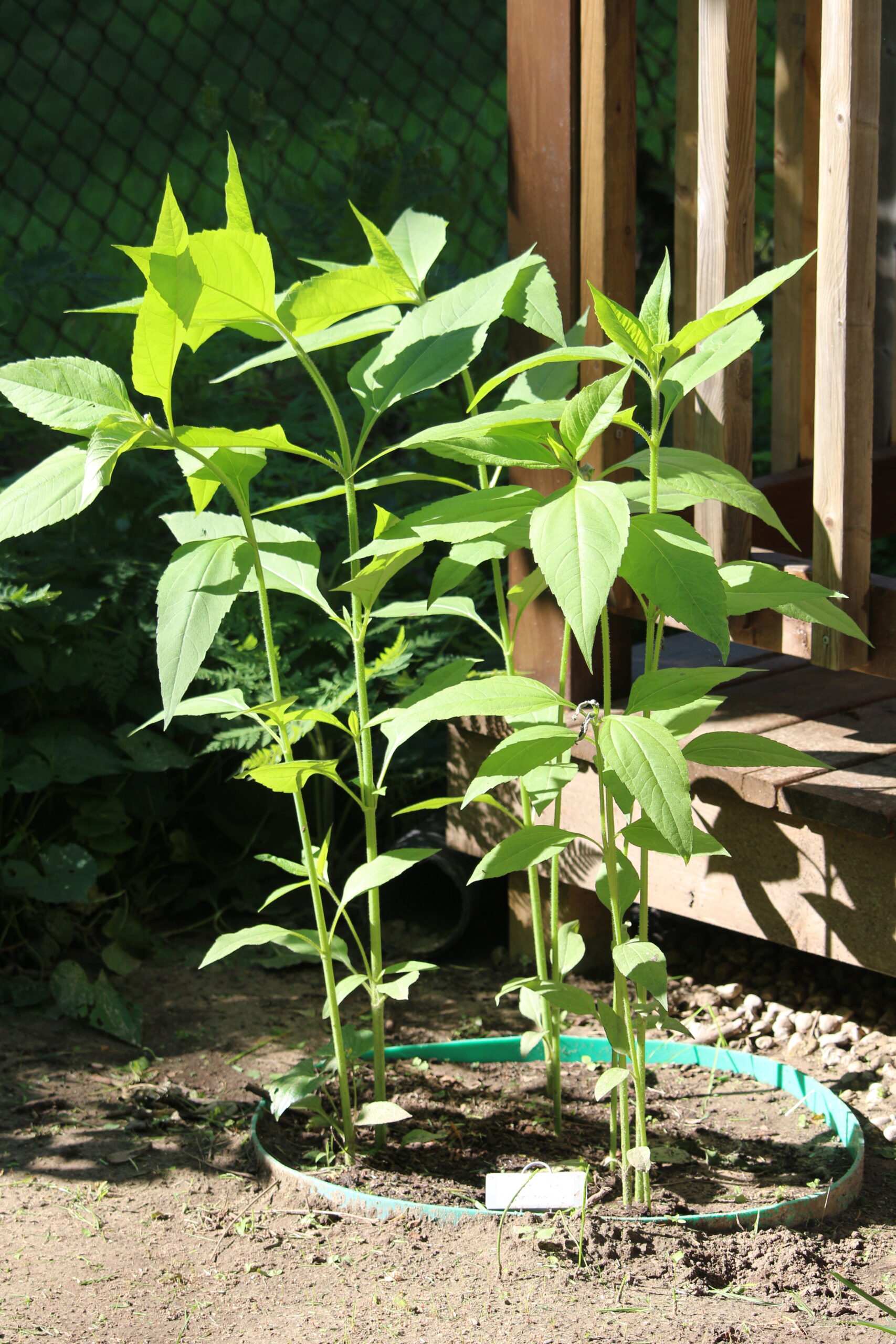
They way I wrapped my head around the terminology is with an analogy: If our military forces came into a major city and started roughing up and arresting people, we’d say they are being aggressive, but if a foreign army did this, we’d say they were invading. The domestic army can’t invade because it’s already here. Same for plants – Canada goldenrod can’t be invasive because it belongs here. But a plant from another part of North America that was never here before CAN be considered invasive. For instance, cup plant (Silphium perfoliatum) was never native in New York state but it is a very aggressive spreader and is therefore considered an invasive species there1, 2 (and it is illegal to sell or grow it for sale in that state).   

Weeds 

Weed is another term that has some confusion surrounding it (I’m not talking about the weed your brother-in-law smokes, either). Weeds may be non-native OR native plants. We’re all familiar with dandelions – some consider it a weed while others do not. This Eurasian-native species was brought by European settlers as early as the 1600s as a food and medicine plant3. Plants like Canada thistle (despite its name, it, too, comes from Eurasia) were brought for the same reasons, or because they were familiar flower garden plants “back home”. These, and many more, have become ubiquitous throughout North America.  But the term weed is actually an agricultural term and describes any plant that has a negative economic impact on agricultural (food) production. In our gardens, is simply a plant that is unwanted where it is growing and in traditional gardening, these often happen to be native species, though not always.  

Erigeron canadensis (Horseweed, or Canada Fleabane) is a prime example of a native plant that is considered a serious weed in agricultural crops, especially since it developed resistance to glyphosate (the major weed-killing ingredient in Roundup) and to acetolactate synthase (ALS) herbicides. Milkweed, especially Asclepias syriaca or common milkweed, was long considered a noxious weed – a special category for the really nasty ones – and was eliminated from farm fields whenever it was encountered. Livestock won’t eat it, its rapidly spreading rhizomes enables it to take over large areas of a field out-competing the farm crops, and it had huge impacts on the farmer’s bottom line. We now know that it is also essential for the survival of the monarch butterfly, and as a result many jurisdictions have removed it from their noxious weeds lists. 


Click any image to view larger version.

Essentially, a weed is simply a plant growing where you don’t want it. In my all-native-plants garden, for instance, I consider squirrel-planted tulips and star of Bethlehem plants to be weeds. (I even refer to my hosta bed under a large maple tree in my front yard as my “weed garden”, and one day it will get “weeded” and native plants put in). 

Cultivars and Nativars 

Some other terms in native plant gardening also bring some confusion, especially to those just starting out. For instance, what’s the deal with cultivars and what is a nativar? The term cultivar is simply an abbreviation for the phrase “cultivated variety”. Nativar is a newer term that has come with the surging interest in native plant gardening and is simply a combination of two terms, native and cultivar.  

When many of us start to grow native plants in our gardens, we bring with us a history of growing non-natives. We, therefore, often look to the exotics for unusual colours or forms. I was no different in this regard – I was in in my 50s, with close to 40 years gardening experience, when I discovered native plant gardening.  When I saw a cardinal flower (Lobelia cardinalis) with a deep burgundy colour, a swamp milkweed (Asclepias incarnata) with a pure white flower, or a bloodroot (Sanguinaria canadensis) with a “double” flower, I was amazed and wanted it in my garden. Most often these plants are simply natural mutations that horticulturalists have latched onto and have cloned for resale. Some will breed true to the new form, but some are one-off freaks of nature whose seeds, if they even produce any, will revert to the original. Others are the result of selective breeding. And because the horticulture trade is, for the most part, driven by profit, some growers will select for unusual colours or forms to meet the demand for exotic plants.  

You can usually spot a plant in the garden center that is a cultivar because the tradition is to include the commercial name (either in quotation marks or not) after the scientific name, such as Aclepias incarnata “Ice Ballet” – note that the scientific name is in italics but the cultivar name is not. The use of var. (for variety, or in Latin, varietas) in the name, as in Cercis canadensis var. alba, is supposed to be used for naturally occurring varieties that have been selected for certain characteristics (in this case, a white version of redbud) rather than for plants that have been specifically bred for the trait. Unfortunately, there is not a lot of consistency in how these terms are used in the trade. (See article #4 in the reference list below for some more detailed explanations of these and other related terms.) 

Click on any image to view larger version.

But as intriguing as some of these unusual variations are, recent research is showing that not all cultivars/nativars are equally valuable to the insects that depend on them5. Nutritional values can vary because the genetics that produce a desirable feature may be connected to those that impact nutritional value (similar to the genetics that make a German shepherd dog look the way it does also makes it susceptible to hip dysplasia). For instance, many of the double flowered nativars either do not produce nectar or pollen – the extra petals in double flowered species is often a mutation where the stamens in a flower are replaced by petals – and are often sterile, while others may be unpalatable to the insects that need it to survive. As the interest in native gardening grows so, apparently, does our interest in nativars and ongoing research is needed to determine which varieties are just as good for the insects as the originals.  

Summary 

You should now be able to confidently explain that, no, Canada goldenrod is NOT invasive, but garlic mustard is (and why). You should also be able to explain to your neighbour why those tulips in your lawn are actually weeds, why the milkweed in your front garden isn’t, and what the difference is. And finally, when shopping for some new plants, if you see a non-Latin name pinned to the end of the scientific name on the plant tag, you’ll know this is (most likely) not a pure native species and, as such, may not have the same value to the insects and other critters that need it to survive.  

Happy native-plant gardening. 

  1. https://nyis.info/wp-content/uploads/2018/01/d8be1_Silphium.perforatum.NYS_.pdf  
  1. https://www.dec.ny.gov/docs/lands_forests_pdf/isprohibitedplants2.pdf  
  1. https://www.fbn.com/en-ca/community/blog/where-did-all-of-these-weeds-come-from 
  1. https://www.mapleleavesforever.ca/cultivar-variety-or-nativar-as-it-relates-to-our-native-maple-species/ 
  1. https://piedmontmastergardeners.org/article/native-species-or-cultivars-of-native-plants-does-it-matter/  

Monarda fistulosa and Friends

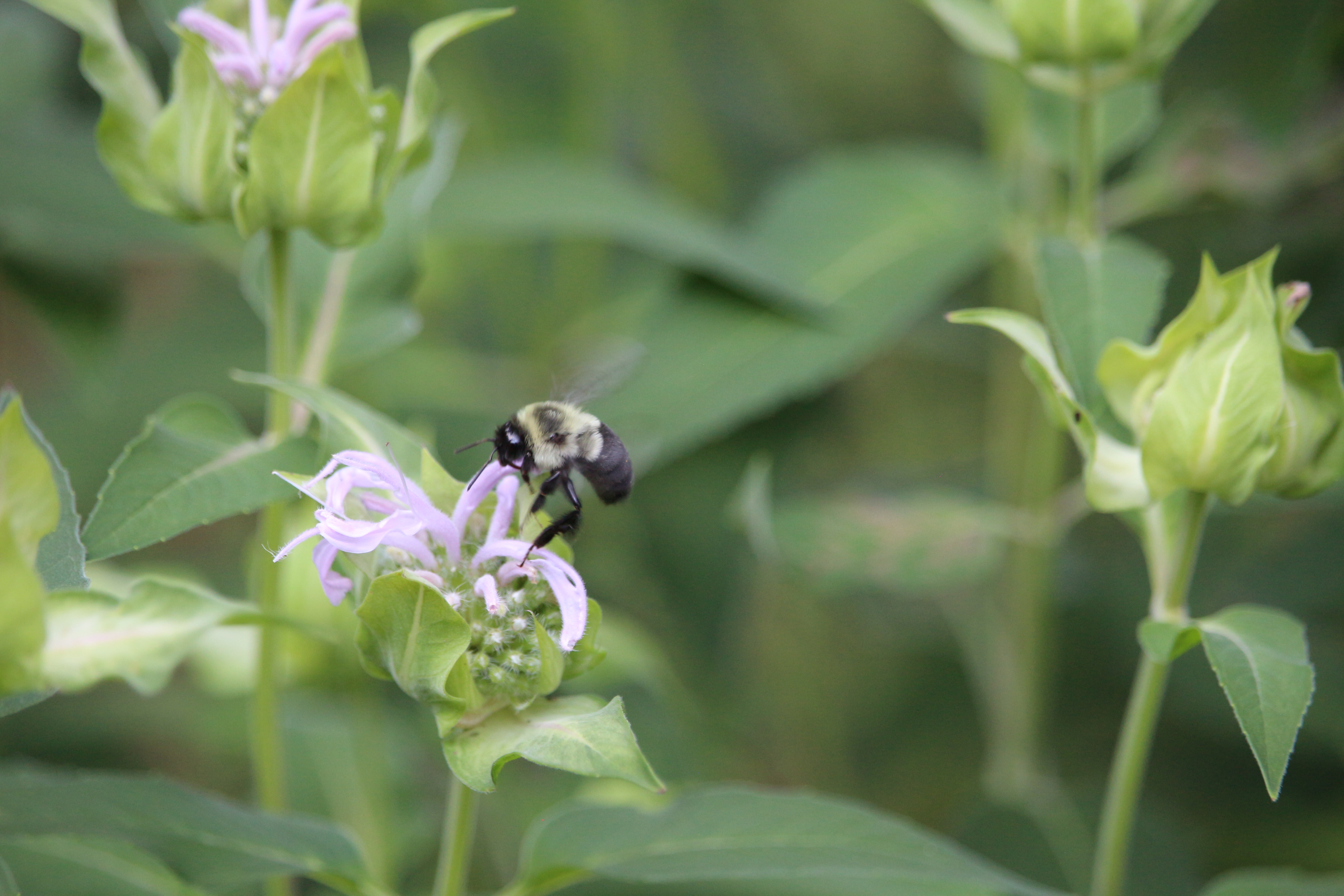
Without a doubt, the most active pollinator attracting plant in my garden (and with over 300 species of Ontario natives and a few near natives, that’s saying something) is Monarda fistulosa, aka Wild Bergamot.  While the flowers are blooming, there is constant activity with bees of all sizes – from tiny ones the size of a grain of rice to large bumblebees – and butterflies, moths, wasps, beetles and even the occasional hummingbird. These just started blooming in my southern Ontario garden in the first week of July and will keep going for a few more weeks. Though susceptible to powdery mildew, my resident bunny never touches it.

(Plant Description and In the Garden sections, below, courtesy of Shaun Booth from In Our Nature.) 

Common Name: Wild Bergamot 

Scientific Name: Monarda fistulosa 

Family: Lamiaceae (Mint Family) 

Alternate Common Names: Bee Balm, Wild Horsemint, Mint-leaf Beebalm, Purple Beebalm 

Plant description: Wild Bergamot features multiple, light green stems that are 4-angled and varyingly hairy. Opposite leaves are found along the stem, measuring up to 10cm long, 3.8cm wide and are borne on 1.5cm long leafstalks. Leaves are broadly lanceolate to ovate, coarsely toothed, hairless to finely hairy and have rounded bases with pointed tips. Branching stems are topped with 7.6cm wide clusters of tubular flowers. Each flower has a tubular upper lip, with protruding stamens and tufts of white hairs at its tips, and a curved lower lip. The outer surfaces of the lips have fine hairs. Flower heads are backed by green bracts that may have a pinkish tinge. Flowers turn into rounded seed heads that contain small, dry, oval seeds. 

In the Garden: Wild Bergamot blooms profusely with pastel purple flower-heads that resemble mini-firework displays. The leaves have a lovely minty-oregano fragrance when rubbed. The rigid stems and rounded seed heads stand strong through the winter months to extend seasonal interest. Herbivores tend to avoid this plant. 

Skill level:  beginner 

Lifespan: perennial 

Exposure: full sun to part shade 

Soil Type: thrives in a wide range of soils, from acid to lime to rich to poor to sand to clay 

Moisture: dry to moist 

Height: 60-120 cm 

Spread: 60-90 cm  

Bloom Period: Jul, Aug, Sep 

Colour: pink, lavender, rarely white 

Fragrant (Y/N): N (but foliage is aromatic) 

Showy Fruit (Y/N): 

Cut Flower (Y/N): 

Pests: powdery mildew can be a significant problem with the monardas, particularly in crowded gardens with poor air circulation; rust can also be a problem 

Natural Habitat: open wooded sites, prairie ditches, meadows, sunny hillsides & rocky slopes 

Wildlife value: Butterflies and many, many native bees are attracted to Wild Bergamot – it is one of the busiest flowers in my garden when in bloom. Hummingbirds may also visit occasionally. The aromatic foliage is unpalatable to most herbivores. 

Butterfly Larva Host Plant For: none 

USDA Hardiness Zone: 3-9 

Propagation: Wild Bergamot is very easy to start from seed, which should be surface sown because they need light to germinate, but they do not need to be cold stratified. Store seeds in a cool, dry environment for spring sowing. Colonizes by rhizomes so lift and divide every 3 years to control its spread, improve air circulation and for general plant health. Most sources recommend dividing in early spring before new growth starts, but I have successfully divided wild bergamot all summer long. Plants may also be propagated in the greenhouse from stem cuttings. 

Additional Info: Not a good choice in a boulevard garden as it has very low salt tolerance. Prefers drier soils than M. didyma. In most years in my garden, the Wild Bergamot becomes white with powdery mildew by the time the blossoms are nearly done, and I often get good regrowth and a second flush of flowers by cutting them back at this time to the lowest set of leaves. 

Native Range: 

Native Range of Monarda fistulosa

A couple more Monardas to consider: The plants below are gorgeous in the garden, but have a much more restricted range than M. fistulosaMonarda didyma is found mainly in southern Ontario, New York and Pennsylvania while M. punctata is native to the very southwestern tip of the province (Essex County and parts of Chatham-Kent) and to lower Michigan and parts of New York. Perhaps I will do a feature on these at a later date. 

Monarda didyma Bee Balm, Oswego Tea, Firecracker Plant, Wild Oregano (and several other common names, is a bright red cousin of Wild Bergamot that will grow to about 120 cm (4’) tall in well drained sand, clay or loam soils in full sun to part shade. Hummingbirds and swallowtail butterflies are especially attracted to the red flowers.  

Monarda punctata: With the least flashy flowers of the three Monardas, the gorgeous Spotted Bee Balm, aka Dotted Horsemint, makes up for it with leafy bracts that turn a glorious pink. It is also the most drought tolerant of the three. In my garden, if you want to see a great black digger wasp (Sphex pensylvanicus) just stand by the M. punctata for a few moments when it is blooming – they are almost always on the plant. 

2b or Not 2b – The Story Behind Plant Hardiness Zones

Most gardeners are familiar with the Plant Hardiness Zone (PHZ) maps that are found in many seed catalogues and garden centers, and with the paired numbering system (2a, 2b, 3a, 3b) etc. found on plant labels.  But what do these numbers really mean? How did they come about? And are they really relevant for native plant gardeners? 

The earliest PHZs were delineated in the 1920s by the Arnold Arboretum at Harvard University. In the 1960s, the US Department of Agriculture (USDA) devised their own set of PHZs using different criteria resulting in two different maps. However, the Arnold Arboretum map remained the standard until 1990, when the USDA, in conjunction with the US National Arboretum, and using data from thousands of weather stations, created the maps we now see. These maps are based on the average minimum winter temperatures. Each zone is marked at 10°F intervals, with the division between a and b at the 5° interval (e.g. zone 6a has an average winter minimum temperature of -10 to -5°F, 6b is -5 to 0°F). The logic behind this system is that plants have a cold threshold they won’t survive beyond.  

USDA PHZ: https://planthardiness.ars.usda.gov 

Unfortunately, these zones are a bit too simplified because plants are affected by more than just minimum winter temperatures, especially the further south you go. In snowbelt areas, for example, temperatures may drop well below freezing, but a deep blanket of snow can keep the plants safe. Basing the plant hardiness zone on minimum temperature doesn’t always work. Regardless of what minimum winter temperatures the plants will succumb to, some plants also tolerate heat much better than others. So the American Horticultural Society (AHS) devised their Plant Heat Zones based on the number of days the temperature went above 30°C (86°F), but their methodology created some problems as well. For instance, some plants can take lots of heat in the daytime but need cooler nights to recover and so just counting the number of days the temperature is above 30°C doesn’t really work. Also, plants like hostas love the heat, but they need cool winter temperature in order to go dormant so that they can start to grow again in the spring.  

AHS Heat Zone Map: https://ucanr.edu/blogs/dirt//blogfiles/37486_original.jpg 

If you’ve ever looked at the Canadian PHZ map, you’ve perhaps noticed that it doesn’t quite align with the USDA map. This is because the Canadian map is likely more properly called a Plant Suitability Map (though it still goes by the Plant Hardiness Zone moniker).  

Canadian PHZ: http://planthardiness.gc.ca/?m=1 

Originally developed in the 1960s, it uses a wide range of variables, not just minimum and or maximum temperature. The variables are: monthly mean of the daily minimum temperatures (°C) of the coldest month; mean frost free period above 0°C in days; amount of rainfall from June to November, inclusive; monthly mean of the daily maximum temperatures (°C) of the warmest month; winter factor expressed in terms of (0°C – X₁)Rjan where Rjan represents the rainfall in January expressed in mm; mean maximum snow depth; and maximum wind gust in (km/hr) in 30 years; and it incorporates them into a complex mathematical formula. You can read more about the formula and how it works here.

The original formula is the result of statistical analysis of the survival of 174 different trees and shrubs from 108 locations across the country (McKenney and Campbell, 2002, Getting into the Zone – what does Canada’s new plant hardiness zones map really mean? Frontline Technical Note #103 – see link to the paper at the end of this article). The newest version of the map was generated using computer models and interpolating climate data generated at more than 3400 locations across the country.  

Which is the best (i.e. most accurate and reliable) system? Being Canadian, I’m probably biased. But it would seem that the more thorough and complex Canadian system is likely the more accurate. The challenge is getting everyone to agree on one system. Most garden centers use the USDA system, probably because it has been around for a long time and the plant labels they purchase (likely from US sources even here in Canada) use that system.  

Surprisingly, even though the American and Canadian calculations are very different, in the southern Great Lakes region the results are close enough to be compatible for most of the plants – although some sources I’ve seen suggest that the Canadian and American systems may differ by as much as one complete zone in some locations. Also, both the US and Canada have been widely mapped using the USDA PHZ criteria, but I’ve not found any maps yet where the US has been mapped using the Canadian system. So, it doesn’t look like we’ll have a unified system any time soon. 

USDA Plant Hardiness Zone Map (North America): http://www.perennials.com/content/plant-hardiness-zone-maps/

But even with all the variables used in the Canadian maps, there are so many things that will affect the plant’s survivability that just cannot be easily mapped. Extreme weather events, microclimates caused by built structures, local topography, even mulching and watering, can have a significant impact on plant survival. 

When it comes to native plants, though, a lot of research is still needed to verify the zones they will survive. Accurate range maps overlaid on PHZ maps will go a long way to answer these questions, but native range of so many of our native plants have not been mapped with any level of detail.  

Then there is the question of whether we should even worry about what areas our native plants are capable of growing in – if the idea is to keep native plants in their native range, the more important issue is to figure out where the plants actually grew before we started putting them in our gardens everywhere. This way our native plant gardening efforts will better serve the insects and animals the plants evolved with, and not just our personal aesthetic.  

Until next time, happy native plant gardening. 

Rick 

Other Resources:

Blue Flag Iris

Beginning to bloom in my garden as I write this, is one of my favourites – Iris versicolor or blue flag iris. Its glorious royal purple blossoms are a real eye catcher. If you have sufficient moisture, it can be a garden show stopper in June before the bulk of the colourful summer and fall natives have started to bloom. (Plant Description and In the Garden sections, below, courtesy of Shaun Booth from In Our Nature.) 

Common Name: Blue Flag Iris 

Scientific Name: Iris versicolor 

Family: Iridaceae (Iris Family) 

Alternate Common Names: American Blue Flag, Dagger Flower, Flag Lily, Harlequin Blueflag, Large Blue Iris, Larger Blue Flag, Multi-coloured Blue Flag, Northern Blue Flag, Northern Iris, Poison Flag, Snake Lily, Water Flag 

Plant description: Blue Flag Iris features sword-like basal leaves that are usually erect but larger leaves may be slightly spreading. They are about 2.5cm wide at the base, taper gradually to a pointed tip and are often purple at the base. Smooth flowering stalks emerge from the base of the plant and are topped by 1 to a few flowers that each measure up to 10cm across. These flowers are a very familiar Iris shape with 3 sepals, 3 petals and 3 stamens. The sepals spread outwards from the center of the flower and each one has a patch of yellow and white at the base with purple veins fanning out from it. The upper lip of this sepal curves up like a shoehorn and forms an open tubular shape with the bottom lip. The petals are found in between the sepals, measure 2/3 the length of the sepals and are violet-blue with dark purple veins. Flowers are replaced by angular, oblong seed capsules that split open to release its seeds. 

In the Garden: Blue Flag Iris steals the show in early summer with its intricate, jewel-toned flowers and its bold, sword-like leaves. The flowers are relished by hummingbirds but deer and other herbivores rarely touch this plant. In addition, the angular seed pods add excellent winter interest. 

Skill level: beginner 

Lifespan: perennial 

Exposure: full sun to part shade 

Soil Type: prefers clay and mucky soils but will grow in most soils (I have seen them growing in the shoulder gravel of a road) 

Moisture: wet, moist – will tolerate short periods of drought 

Height: 60-90 cm 

Spread:  60-75 cm 

Bloom Period: May, Jun, Jul 

Colour: blue/purple 

Fragrant (Y/N):

Showy Fruit (Y/N):  N   

Cut Flower (Y/N):

Pests: susceptible to a number of insect pests including iris borer, iris thrips, and aphids and potential disease problems include various rots (rhizome rot, crown rot, bacterial soft rot) leaf spot, and leaf/blossom blight while aphids can spread mosaic virus 

Natural Habitat: marshes, swamps, shorelines, wet meadows, margins of ponds and creeks, sedge meadows and borders of wetland forests 

Wildlife value: attracts butterflies and native bees. Hummingbirds seek nectar from the flowers. 

Butterfly Larva Host Plant For: none 

USDA Hardiness Zone: 2-7 

Propagation: [C(120), M; D] Seeds should be sown when fresh or, if sowing later, stored in a cool, moist setting (most sources say they do not tolerate drying out – though Cullina claims they do just fine stored dry). They require at least 4 months cold, moist stratification to germinate and will take 2 years till they produce flowers. To propagate vegetatively, the roots can be divided in early summer and potted or planted along the water’s edge. 

Additional Info: In smaller water features, consider growing this in large pots submerged to the rim. 

Native Range:

Iris versicolor is a northern native, growing along streambanks, lakes and ponds, and in open wetlands.

Book Review: The Northeast Native Plant Primer: 235 Plants for an Earth-Friendly Garden

The Northeast Native Plant Primer: 235 Plants for an Earth-Friendly Garden

By Uli Lorimer

  • Publisher: ‎Timber Press, 2022
  • Paperback‏:‎ 252 pages
  • ISBN-10: ‏ 1643260464
  • Dimensions: 8” X 9”
  • Price: $31.94 (Amazon.ca); $22.46 (Amazon.com)

A beautiful but brief synopsis of native trees, shrubs, vines, wildflowers, ferns, grasses, sedges and rushes suitable for gardens in the northeastern US and southeastern Canada (from the Maritimes through southern Quebec and into southern Ontario).

I’ll start by saying that the quality of the book and the images is fabulous – just what I’d expect from Timber Press. I love just looking at the pictures. Unfortunately, at least from a serious native plant gardener perspective, that’s about where it ends. Like its predecessor – The Midwest Native Plant Primer: 225 Plants for an Earth Friendly Garden by Alan Branhagen – it falls short in so many ways from becoming a truly useful book. The one MAJOR improvement over the Midwest Primer is that in this book, at least, the plants are listed in alphabetic order by scientific name. For one thing, this keeps all the similar plants (e.g. milkweeds, oak trees, etc.) together in the book. And for another, it overcomes the issue of the huge variability in common names found throughout the region.

The book starts, as this genre usually does, with an introduction covering a variety of related topics. These include such things as: the definition of a native plant, expecting and living with change as your garden evolves, straight species vs cultivars (Lorimer believes, as I do, that the straight species is always the better option), preparing the new garden bed, soils, moisture and light, etc. The intro also includes a fairly lengthy section listing the plants in the book that are hosts for various moths and butterflies and which moths and butterflies those are. Finally, the book also includes some simple icons with each plant indicating if the species is valuable for birds, pollinators, butterflies, caterpillars and/or mammals, reptiles and amphibians.

That’s what I liked about the book. Now for where I felt it let me down and could have been more useful.

It states in the intro that each profile includes information on current scientific name, common name, native habitat, height at maturity, light requirements, wildlife value and a description of the plant. It does. Sort of. The level of information is so brief, however, that I came away feeling like I needed more information. One short paragraph covers all of this info. There is little or no information on propagation, on WHERE in the northeast the plants are native to/can be grown, and even though the author talks about plant hardiness zones in the intro and even provides a chart at the back explaining how it works, none of the plant descriptions indicate the hardiness zone. Why was it brought up in the first place if you’re not going to include the information for each plant. But to me, the biggest flaw is that the book does not tell me if a plant is native to where I live or not. The Northeast covers a lot of real estate, climate zones, geological variability, soil types, etc. and there is no indication in the book as to where the plants are actually native to. It is my belief that native plant gardeners, more so than any other type, want to know if a plant is actually native to where they live. There are few other minor things (like only listing one common name for each plant) that do not really detract from the book.

All in all, it’s a beautiful book to look at, and can give you some ideas for plants you can try growing. It’s nice enough that even after my disappointment, I will be keeping in on my shelf as a handy, quick reference. But it really is just the starting point. Once you find a plant in it that you like, you’ve got a fair bit of work ahead of you before you will know if you should try growing it or not.

© The Native Plant Gardener 2022

Can I have continuous bloom in my native plant garden? Part 2

In my previous article, I discussed continuous blooms for the shady garden as a response to someone’s query, so in this piece I will look at plants for the “average” garden – moist to dry soils, full sun to part shade. (Unless noted otherwise, all images are from my southwestern Ontario garden.)

Part 2 – The Less Shady Yard

When I started growing native plants in my garden, I was disappointed that for much of the early part of the growing season there wasn’t much colour in my garden. Once the spring ephemerals like trilliums and bloodroot were finished in the shade garden, nothing much happened till July. It seemed to me that Mother Nature only offered native colour in the summer and fall. So that’s when I started to dig deeper into the native plant literature. It didn’t take me long to start finding the missing pieces. In this article, I will offer up some native plant choices that will help you provide colour in your garden, and food for the local pollinators, from spring right through till the snow comes.

April/May/June – May is when some of my favourite native plants start to bloom. Geum triflorum (prairie smoke) starts to blossom in early May and continues well into June. It has an unusual pink blossom, but it’s the wispy pink seed heads that give this plant its name and is the real attraction in the garden. I have seen fields of prairie smoke in Manitoba, and it does look like smoke laying close to the ground. Planted in swaths as a foreground plant, it can provide quite a show. Another interesting foreground/rock garden plant is Antennaria neglecta (field pussytoes), with its white tufts of flowers that give it its common name. Note that Antennaria is a host plant for the American Lady butterfly.

We have a couple of very low-growing buttercups that bloom very early in the spring, too. Ranunculus rhomboideus (prairie buttercup) produces yellow flowers in late April – often one of the very first flowers to blossom in my garden – and R. fascicularis (early buttercup) starts to flower about 2-3 weeks later. Prairie buttercup keeps flowering for several weeks, too.

Zizia aurea (golden Alexander) blooms from early/mid May for about a month with wild-carrot like foliage and bright yellow flowers. This is a host pant for the black swallowtail butterfly. The first time I grew one of these, I found 7 black swallowtail caterpillars on the single plant. (I have since planted many more!). I find they do self seed quite a bit, but the heavy seeds do not seem to land far from the parent plant.

The hummingbirds love my Aquilegia canadensis (wild columbine). In my southern Ontario garden, it usually starts blossoming in early to mid-May and provides that first splash of reds/oranges for the season. This tough little perennial loves to self seed, and I let it pop up anywhere it wants in my yard – from full sun to full shade, in bone dry soil to consistently moist soil. Around the same time, my Capnoides sempervirens (pale corydalis or rock harlequin) starts to flower. This delicate little flower is an annual (sometimes biennial) that blooms right through till late fall. It, too, is a prolific self seeder, and though it doesn’t tolerate as much shade as wild columbine, it doesn’t seem too fussy about moisture. Often found in shallow soils on alvars, this plant is another with a two-tone blossom – pink and yellow.

Coreopsis lanceolata (lanceleaf coreopsis) starts to bloom in late May/early June in my garden and is another long-lasting splash of yellow – staying in continuous bloom well into mid-summer. And if you have the right soil (sandy, well drained), Lupinus perennis (wild blue lupine) flowers around the same time, and is host for the endangered Karner blue butterfly.

Phlox also starts to bloom in May – Phlox divaricata (wild blue phlox) and P. subulata (moss phlox) are Ontario natives, P. stolonifera (creeping phlox) is native just south of the Great Lakes. These range from blue, to white, to hot pink. (P. subulata is very common in garden centers – look for the true species rather than cultivars – which are denoted with a name in quotation marks, such as ‘Candystripe’ or ‘Ice Mountain’.) Be warned, though, that phlox seems to be a favourite on the menu for your local rabbits.

There are lots more late-spring/early-summer natives, like Geranium maculatum (wild geranium), Tradescantia ohioensis (Ohio spiderwort), Oenothera pilosella (prairie sundrops), and even Packera paupercula (balsam groundsel), but this list will give you a good start.

July/August – this is when all the showier native plants come into their own. I personally like the yellows of Coreopsis lanceolata superimposed with the oranges of Asclepias tuberosa (butterfly milkweed) – a combination I discovered by accident when my milkweed self seeded into another garden bed. Our lilies (Lilium canadense and L. michiganense) give great shows in mid to late summer, as do many of our sunflowers, coneflowers, mountain mints, Monardas (didyma, fistulosa and punctata), and all of our Asclepias (milkweeds). Our Allium cernuum (nodding wild onion) looks lovely in part shade.  See the table (below) for a list of several more late summer bloomers.

September to snowfall – fall is the time for goldenrods and asters. (And, no, goldenrods do not give you hayfever – it’s the wind-borne pollen of ragweed that blooms at the same time that is the culprit.) Some goldenrods are very aggressive, and should only be planted in appropriately large spaces – like Solidago canadensis (Canada goldenrod), S. juncea (early goldenrod) and Euthamia graminifolia (grass-leaved goldenrod). But many are very well behaved, and even have interesting foliage and flowers. These include S. rigida (stiff goldenrod), S. speciosa (showy goldenrod) and the more unusual white goldenrods – S. ptarmicoides (upland white goldenrod) and S. bicolor (silverrod).

As for asters – take your pick. There are so many, and they range from blues to pinks to whites, from short to tall, from full sun to part shade, from dry soils to wet. A few of my favourites are Symphiotrichum oolentangiense (sky blue aster) – a full sun, medium height plant that will be covered with gloriously blue blossoms; S. novae-angliae (New England aster) – a tall, pink to purple aster that handles being cut back in early summer by 1/3 to produce a shorter, thicker plant with a profusion of flowers; S. ericoides (white heath aster) – a smaller white aster with a lacy foliage and a profusion of tiny white blossoms in full sun; and the very tall (up to 6’ or more) Doellingeria umbellata (flat-topped white aster) which loves full sun and moister soil than many of the others.

Helianthus tuberosus (Jerusalem artichoke) flowers well into the fall – but be careful where you plant it as it will spread by its underground tubers. I planted mine in a plastic 45 gal barrel, cut in half and sunk into the ground. This way I get great tasting tubers in the fall and don’t have to worry about the plant taking over my yard. (This technique works well for other spreading plants, like common milkweed, the aggressive goldenrods, and others.) Helenium autumnale (sneezeweed) is another late bloomer, as is Coreopsis tripteris (tall tickseed) and Heliopsis helianthoides (false sunflower). And many of the earlier bloomers will still be blossoming well into the fall – plants like Monarda didyma (bee balm), Rudbeckia hirta (black eyed Susan), Rudbeckia laciniata (green headed coneflower), Silphium perfoliatum (cup plant), Silphium laciniatum (compass plant), and Vernonia missurica (Missouri ironweed).

Happy COLOURFUL gardening, all season long.

Native Plants of the Midwest

Native Plants of the Midwest

Book Review 1

Native Plants of the Midwest: A Comprehensive Guide to the Best 500 Species for the Garden

By Alan Branhagan

  • Publisher ‏ : ‎ Timber Press, 2016
  • Hardcover ‏ : ‎ 440 pages
  • ISBN-10 ‏ : ‎ 1604695935
  • Dimensions ‏ : ‎ 8.5” X11”
  • Price: $44.47 (Amazon.ca); $38.97 (Amazon.com)

This big and beautiful text is the Midwest’s answer to Donald Leopold’s Native Plants of the Northeast: A Guide for Gardening and Conservation (Timber Press, 2005). The large format, hardcover volume is a comprehensive encyclopedia of garden-worthy native plants of the region. Unlike Leopold’s book, this one appears to have photos of every plant listed (my one major beef with Native Plants of the Northeast). And unlike Branhagen’s other book on the topic – The Native Plant Primer (Timber Press, 2020) – this book lists species alphabetically by scientific name – a much more logical way to do it than by common name, as common names often vary from region to region.

A fairly lengthy (approximately 80 page) introduction discusses the importance of native plants in the landscape as well as in the garden, and includes chapters on plant selection and on garden design.

The book is then divided into 12 sections of “Plant Profiles” – Shade Trees, Evergreen Trees, through Shrubs and Vines to Perennials, Bulbs and finally Annuals and Biennials. He even breaks down the Perennials into Prairie, Woodland and Wetland Perennials. Most of the plant profiles contain a short paragraph (or occasionally 2 paragraphs) about the plant. It then provides a paragraph on How to Grow which describes general soil and moisture needs, another on Landscape Use and another on Ornamental Attributes. A few contain a paragraph on Related Plants as well. Each plant description includes one photo of a general characteristic – whether that be an overall view of the plant, a picture of its fruit, or a shot of the flower.

Overall this is a great book for the gardener who wants to explore the world of native plants, and as a beautiful picture book, I would give it 5 stars. But as a valuable tool for gardeners, I only give it 4 stars for one major problem that I see.

The author devotes a section in the introduction to talk about plant hardiness zones and heat zones, and then provides a table at the back of the book that defines these zones, but not one single plant description includes what zones it will grow in. The Midwest is a very large expanse of geography and climate, and there are many plants that grow in the north that won’t survive the summer heat of the south, and likewise southern plants that won’t tolerate the freezing temperatures of the northern parts of the region. In addition, soils and microclimates will further impact where the plants grew before humans began drastically modifying the landscape. Native plant gardeners, more than other gardening enthusiasts, are very interested in whether a plant is actually native to where they live. No range maps are provided. And even though the author includes a map delineating the Midwest, subdivided into ecoregions, and another that breaks the Midwest into 4 sections (Upper, Lower, Eastern and Western), there is only a very general indication in the How to Grow section of the plant descriptions as to which areas the plants were native to. I would have much preferred a clear range map for each plant.

If you’re looking for a beautiful coffee table book that will give you some ideas about native plants, this one provides a pretty comprehensive list of choices. Because of what I see as a serious flaw as far as plant ranges go, I couldn’t give it 5 stars, but I would give it a 4.5/5.

This book is available on Amazon.

Blue-Stemmed Goldenrod

Blue-stemmed Goldenrod flower

Common Name:  Blue-stemmed Goldenrod         

Scientific Name: Solidago caesia

Family: Asteraceae (Aster Family)

Alternate Common Names: Woodland Goldenrod, Wreath Goldenrod

Plant description: Blue-stemmed Goldenrod has sparingly branched, arching stems that are green when young but turn blueish purple with age.  Leaves are alternate, elliptic-oblong (long and rounded) in shape and measure about 12cm long, 2cm wide and become smaller as they ascend the stem. They are stalkless, hairless and have serrated edges. Small clusters of 1-12 yellow flowers develop from upper leaf axils (where the leaf meets the stem) and at the very tip of the stem. Each flower is 3mm wide and has 4-5 ray flowers (petals) surrounding 4-5 disk flowers. At the base of each flower, you will notice small bracts that are overlapping, smooth and oblong. Flowers mature into small, finely haired seeds that have small tufts of hairs attached to them.

In the Garden: Blue-stemmed Goldenrod is a shade-loving goldenrod with a well-behaved clumping habit. As if its graceful, arching stems and dark green leaves aren’t reason enough to love this plant, it is adorned with bright yellow flowers late in the season that make it a real crowd-pleaser.

Early spring leaves of blue-stemmed goldenrod

Skill level:  beginner

Lifespan: perennial

Exposure: medium shade to full sun

Soil Type: most well drained soils; tolerates poor soil

Moisture: medium to dry

Height: 45-90 cm

Spread:  30-60 cm

Spacing: 45 cm

Bloom Period: late-Aug, Sep

Colour: yellow

Fragrant (Y/N): N

Showy Fruit (Y/N): N

Cut Flower (Y/N): Y

Pests: no serious insect or disease problems though rust may be an occasional problem

Natural Habitat: rich, deciduous or open woods, the edges of woods and in clearings

Butterfly Larva Host Plant For: none

Wildlife value: attracts native and honeybees, wasps, flies and butterflies and the seeds are occasionally eaten by the several small songbirds

USDA Hardiness Zone: 4-8

Propagation: Small seeds need light to germinate and benefit from 90 days cold, moist stratification. Mature plants may be divided and new plants may be started from stem cuttings.

Additional Info: This species is primarily clump-forming and does not spread aggressively as do some of the other goldenrod species and hybrids.

Native Range:

Tell tale blue stem of the blue-stemmed goldenrod

Can I Have Continuous Bloom in My Native Garden? Part 1

Part 1 – The Shade Garden.

In northeastern North America (where I live), Mother Nature likes to constantly change things up. Few of our native plants stay flowering for more than a month or two, and some for only a few weeks. But, in nature, bees and other insects cannot survive for long periods without flowers, so there ARE plants blooming from early spring right through till snow covers them. Unfortunately, the bees (and we) need to search them out.

In the spring, our earliest blooming plants tend to grow in forests as spring ephemerals – they open before the trees leaf out, then disappear once the tree canopy closes in. Plants like Hepaticas (Hepatica americana and H. acutiloba), Jack in the Pulpit (Arisaema triphyllum), White and Red Trilliums (Trillium grandiflorum and T. erectum), Bloodroot (Sanguinaria canadensis) and Trout Lily (Erythronium americanum) all provide a nice, early splash of colour. By mid-May, though, most of these plants have finished blooming. If you have a shady yard, the rest of the season can be pretty bleak – one reason, I suppose, that non-native hostas are so popular. (Did you know that in Japan, where hostas are native, the young spring shoots are collected and eaten like asparagus?)

(Clicking on image will show larger image)

In the fall, a few shade tolerant plants will blossom, taking advantage of the falling leaves that allow more light to reach the ground. These include Zig-zag Goldenrod (Solidago flexicaulis), Large Leaf Aster (Eurybia macrophylla), Upland White Goldenrod (Solidago ptarmicoides) and Blue Stemmed Goldenrod (Solidago caesia), which all do well in dry shade. If you have more moisture, you can add such things as White Snakeroot (Ageratina altissima), Sweet Joe Pyeweed (Eutrochium purpureum), Obedient Plant (Physostegia virginiana) or Blue Wood Aster (Symphiotrichum cordifolium) for a little more variety.

For shade gardens, ferns are a great choice to fill in the blank period between spring and fall. If you have some moisture, you can grow many different fern species, but if your shade is dry (the worst kind, from a gardening perspective), you are much more restricted. But there are some ferns that will grow in dry shade, though maybe not without a little help in very dry years. These include Lady Fern (Athyrium filix-femina), Christmas Fern (Polystichum acrostichoides), Eastern Wood Fern (Dryopteris marginalis) and Hay-scented Fern (Dennstaedtia punctilobula). Both the wood fern and the Christmas fern are evergreen, so they will provide that splash of green in the garden that we long for as the snow starts to melt. Hay scented fern can be quite aggressive, and is really only suitable if you have lots of space that needs filling, and don’t mind managing its spread once in a while. But even Ostrich Fern (Matteuccia struthiopteris) – the one we get edible fiddleheads from – does well in my dry full-shade garden under large Sugar Maples. In dry years they will go dormant in mid-summer if I don’t water them once in a while, but they always come back. They positively thrive in moist shade. Be forewarned, though, they will eventually spread beyond the garden setting – however, they’re easy to dig out to sell or give away to friends and family.

Most folks don’t realize it, but we do have some plants that can provide colour in the shade through the summer, if the shade isn’t too dense (think Tulip Tree, Kentucky Coffee Tree or a younger Sugar Maple or even a young Black Walnut – but not Norway Maple). Harebell (Campanula rotundifolia) will tolerate dry shade, starts to bloom in June and will go all the way through to the end of September. Evening primrose (Oenothera biennis) is another long-flowering plant that blooms from June to the end of August (sometimes even later) and tolerates light, dry shade.  And then there are shorter blooming plants that that can stagger the colour throughout the summer.

During the first half of the summer, Canada Anemone (Anemonastrum canadense), Wild Geranium (Geranium maculatum), False Solomon’s Seal (Maianthemum racemosum) Hairy Beardtongue (Penstemon hirstutis) and even Virginia Spiderwort (Tradescantia virginiana) will do well in dry shade. (The more northerly Ohio Spiderwort (T. ohiensis) prefers a bit more light and moisture than its southern cousin, so if you have medium to moist light shade, it will do just fine). We also have several species of violets that will tolerate medium to dry soils in light shade – some will even tolerate fairly heavy shade. And violets come in a nice range of colours, too. Canada Violet (Viola canadensis) is white, Downy Yellow Violet (V. pubescens) is lemon yellow, and the very interesting looking Long-spurred violet (V. rostrata) is a pink or pale purple.

In my southwestern Ontario garden, Wood Poppy (Stylophorum diphyllum), which most books will tell you likes full sun to part shade and moist conditions, thrives under my large sugar maples in dry soil and starts flowering in early May. In a good year, it can still be flowering well into the summer, though normally it just lasts for three or four weeks. And contrary to everything I’ve ever know about Blue Lobelia (Lobelia siphilitica), I have volunteers coming up in that same dry shade year after year.

If you’re lucky enough to have moist shade, there are lots of options available for colour all season long. Most of the plants already listed will tolerate moister soils (with the exception, perhaps, of Blue Stemmed and Zig-zag Goldenrods). In mid-summer, if it’s not TOO dry, Black Cohosh (Actaea racemosa) will send up its tall white spires in shady settings in June and July, along with Poke Milkweed (Asclepias exaltata). And if the shade is not too heavy, even Wild Columbine (Aquilegia canadensis) will flower from May to July and Anise Hyssop (Agastache foeniculum) from end of June to the middle of September. Virginia Bluebells (Mertensia virginica) are an early bloomer that makes a great companion plant with Ostrich Ferns, sending up their pink and blue flowers just as the fens are starting to unfold. And the brilliant red of Cardinal Flower (Lobelia cardinalis) will light up the light-shade garden in average to moist soils in July and August.

So with a little careful planning, you can have continuous colour in most shade gardens. The list of suggestions provided here is by no means exhaustive – there are lots more plants that will grow in shade, but this will give you a start in your planning.

Next time: Continuous colour in the rest of the yard.